It was perhaps two years ago now, maybe more, when an account on Twitter with a reputation for going after marginalized creators admitted – I paraphrase – that they went after marginalized “problematic” creators on purpose. They wanted them to lose their jobs, their livelihood, to be driven to the streets. They were not welcome in their community, ever. They weren’t ‘accidentally’ depriving vulnerable people of their income and safety nets; it was their intent, from the start, and believed the people in question deserved it.
Possibly around the same time, possibly earlier – the dates get fuzzy – an account from a slightly different part of Twitter said something eerily similar. They said (I am once again paraphrasing) that when sites would not take action against racist fictional content or its creators, it was up to activists to “make their lives hell”.
I’ve deliberately taken as much identifying information out of these anecdotes as possible. As a result, they’re not direct quotes. They might be inaccurate, at least in part; I might be ascribing to one what another actually said. But these things were said; that much I know. Why take out the identity of people who’d say such obviously awful things? Because – well – ultimately, the people who said these things may or not believe them. They might be operating in bad faith, they might have ulterior motives, they might genuinely be this zealous. But it’s also part of a pattern.
Online harassment has been a thing almost as long as the internet itself has. However, as the interconnectedness of the internet itself increases and continuously piles us closer and closer, condensing us into ten, five, three social media sites – it’s taken on a very different nature than the flame reviews and anon brigades of twenty years ago. Certainly 2001 wasn’t fun. But somewhere along the way, two very different concepts have coalesced into some monster that combines the worst parts of both. What is the difference between twenty thousand people pressuring a state senator to do the right thing, and twenty thousand people telling off Rick Riordan for a bad authorial decision? What’s the critical tipping point between harassment and simply a lot of people involved in earned backlash? And at what point does “a lot of people saying the same, obvious, thing” become a tidal wave of bad-faith negativity? It’s not an easy distinction.
Both of the people quoted at the beginning, at least from an idealistic standpoint, are operating from points that make sense. They’re wary of bigots and predators. Deplatforming is, after all, a form of collective action that came from the left. One of the most efficient weapons against a bigot is to simply remove their ability to spread their ideas; this is the logic behind Alex Jones’s banning from most social media sites, which had a notable effect. Donald Trump’s final banning from Twitter actually decreased violence in the U.S.A. as a whole, after four years of his inane tweets nearly starting wars. Even on a smaller scale, this works; the band Lostprophets was a staple of the alt-rock scene for a long time, until 2013, when Ian Watkins (the lead singer) was outed as a monstrous serial child abuser. His other band members dropped him like he was toxic (and he is) and he went to jail – but since he’d still be getting royalties, they made a new band, and the name Lostprophets became anathema. You won’t hear Lostprophets played or even mentioned in most places anymore, and Ian Watkins is rotting away in jail. And the opposite, tragically, plays out in reverse; harmful shows like 13 Reasons Why get multiple seasons because of ‘hate-watching’, and the choice to ‘separate the art from the artist’ while still putting money in the pockets of transphobes has kept the career of J.K. Rowling enduring long past what would have been its natural sell-by date.
So, logically, deplatforming should be a perfectly fair and leftist thing to do. How has it warped into something abusive? Well, point one, there’s nothing that is beyond appropriation by abusers. Nothing is so Theoretically Good that it is beyond abuse. TERFs (Trans-Exclusionary Radical Feminists) and other right-wing bigots have realized to great effect that mass-reporting a single account will eventually get it suspended, whether or not it did anything wrong – to name one example.
But point two, and more challenging, comes back to Audre Lorde. “For the master’s tools will never dismantle the master’s house. They may allow us temporarily to beat him at his own game, but they will never enable us to bring about genuine change. And this fact is only threatening to those women who still define the master’s house as their only source of support.” Often, only the first part of this is quoted. The original essay is from 1984 and still extremely relevant, but the full quote is also important. Deplatforming is a useful tool. It is also a temporary one; a stopgap. And – more than anything else – we should not lose sight of who invented deplatforming (or “cancel culture”, if you’d like to bring it home that way). Perhaps leftists are the ones who brought it online or made it crowd-sourced, but the careers of Eartha Kitt, Zero Mostel, and Janet Jackson did not fizzle out or come to a halt on their own. Or, more brutally, the murders of Martin Luther King Jr. and Fred Hampton – the same principle, taken to its logical extreme, to silence what the state did not want said. This isn’t me comparing a “Silence, TERF” meme to those murders, to be clear. But it would be irresponsible to ever be entirely comfortable with the concept, no matter who’s wielding it.
This is all pretty theoretical, so I’ll bring it back to the main point. What’s the difference between online harassment and online criticism or deplatforming? The border, in my opinion, is going to keep shifting with context, time, etc. But one of the critical points on that border is ‘desired outcome’. Let’s take a racist or otherwise problematic depiction in a book. You take to Twitter, or Tumblr, or Facebook – pick your public forum – and criticize it. Perhaps the author responds! Perhaps they don’t. Now, if an author or author’s friends decide that your one piece of criticism is harassment, that’s clearly bad faith. (Exceptions: if you’ve been going after this author for a while, block-evaded, etc. but that should speak for itself.) But say other people are pointing it out. Again, not harassment. Even if others disagree on whether or not it’s a problematic depiction, A public piece of art is allowed to be discussed in public.
Alright. Let’s say the author apologizes. It might not be a good apology. It’s common to see the “I’m sorry YOU felt hurt” or the half-assed “apologizing for the wrong thing” apologies here; there’s also a common issue of interpreting apologies as being bad faith because you’re still mad at the person. Or perhaps the apology isn’t accepted because the depiction isn’t fixed. (This can vary! The author might not have any more control, if the book’s already published; this is especially true of older novels getting renewed circulation. Certainly asking G.R.R. Martin to fix something in Game of Thrones for future editions wouldn’t be particularly effective.) You’re under no obligation to accept the apology; but what good does it do to escalate? This is where a very specific change happens; instead of alerting somebody to an issue and asking them to change it and understand the problem, you’re pressuring them to change it “or else”. It depends on the nature of the escalation, but online harassment can involve using emails, contact info, phone calls or even contacting agents to apply pressure. The “or else” becomes pretty explicit at that point. I’ve even seen doxxing enter the picture. And while I’ve used racism as my example here – this all takes on a newly horrifying angle when the seemingly-justified reasons give way to accusations of “promoting pedophilia”, “profiting off of other people’s trauma” (without any grounds for that accusation, usually), “creating child pornography” (fiction does not work that way), or even, horrifyingly, “faking being queer” or “not really being part of the community” usually aimed at bi, ace and non-binary authors. It goes on.
So what do you actually want to accomplish when you go after somebody? If you’d like an apology, go in with an intent for an apology – and if it’s a bad one (not just an awkward one) then change tack towards something else. But too often, I see something start with a masquerade of Fair Criticism – then just keep going. Anti-shipping is full of this, but it’s not the only offender. What do you want from a content creator if they’ve acknowledged a problem? You’re not likely to change their mind at that point – and any minds changed through constant, boundary-crossing pressure are minds “changed” in a way that not only use the master’s tools, but glory in them in a way that I, for one, want no part of.
And then, what is actually garnering this reaction? Scale has gotten lost just as much as intent. I’ve used the publishing world and authors in this very much on purpose; fandom sits on one end of the scale, and U.S. governmental officials very much on the other. The people quoted at the beginning of this article may very well have started from places that made sense. Punching Nazis is great. I’m all about punching Nazis. I am all about annoying senators and governors into vetoing trans healthcare bans and passing assault rifle bans, by sheer force of numbers. I greatly approve of K-poppies using fancams against cops in the greatest possible “Nyeh nyeh nyeh-nyeh-nyeh” of all time. But the reason this works – the reason this is ethical – is because the number of people affected and the number of people involved stands a good chance of being equal, if not leaning heavily towards the former. Or, more simply, people with big platforms should expect big blowbacks. It’s part of the job. (Inasmuch as large social media platforms necessarily line up with ‘jobs’, but that’s a slightly different discussion; and it’s very true that somebody who gains 50k followers through cat memes is still going to have less influences than the POTUS Twitter account.) Somebody who posts a fanfiction with racist tropes that are more likely than not completely accidental or subconscious? There’s no world in which you can argue that a fanfic with 50 kudos suddenly getting 500 to a thousand critical comments (and usually hateful ones, when it comes to the fanfiction side of things) is being “deplatformed” and not just bullied.
Scale isn’t just about exposure, either. My final point on this is that, while everything is politics, not everything is Politics. Fighting for the rights of transgender children is not comparable to fighting for trans representation. Both are important. One affects our lives directly. The other is part of the cultural milieu; a helpful factor that is part of a literary and media landscape that no one person can shift one way or another. The pressure of thousands of people isn’t something to try invoke lightly, and while what happens by accident is beyond most of our control (the nature of viral threads is probably worth a whole PhD study on its own) it’s irresponsible and almost insulting to try summon it for “possible, maybe” predators and Bad Fiction. If you’d like to criticize it, criticize it; if you think the weight of numbers is what will lend your criticism validity, then you don’t have faith in your own analysis. And I think some of us do this unconsciously. We want others to back us up. We want to believe that our causes are all as important as each other – and they are. But there’s important and there’s time-critical and there’s ones with lives at stake, and sometimes you’re just using public humiliation as a cudgel.
I don’t think this is a monster that any one person can dissect, unfortunately. I can make some distinctions here and there; but there’s things I haven’t even touched on (for example, at what critical mass does ‘fair crit’ become harassment when the participants don’t even realize they’re doing it?) and of course, the always-tricky angle of how public pressure can become harassment when done to a more vulnerable population by dint of existing stereotypes and bias. But as the Left goes through growing pains and re-examines a lot of third-wave feminism’s baggage in light of Web 2.0’s changes, I think this is a topic that will come up more and more – and it’s worth keeping in mind the next time you’re tempted to get on the latest bandwagon, no matter how large or small it might seem.
This happens to me a lot. Whether it’s because I’m a little rough around the edges, or whether it’s because I’m a person of color or Jewish, or because I’m trans, or because I’m a narcissist with borderline and bipolar and all of those other terrible things, it really stops mattering. It always happens the same way. I will make, perhaps, a friend. Sometimes we’re not that close! Sometimes we’re super close. Sometimes – more than once – a horrible number of times – this is a significant other, a loved one, a boyfriend, a girlfriend. Sometimes they like me more than I like them. Sometimes I like them more than they like me. Even when it’s a little uneven, it’s usually mutual.
But here’s the thing: They will like me – you will like me for what you call ‘honesty’, ‘straightforwardness’, a willingness to be uncompromising about my morals while also caring about nuance, a ferocity when it comes to my principles. You cheer, perhaps, when I chew out somebody you think deserves it. Maybe they did. Sometimes they didn’t! Sometimes I’m uncomfortable with others’ glee, unhappy with how my symptoms have overtaken my sense in a particular situation.
And they are symptoms. I struggle with anger. Anger, and sadness, and euphoria – both my borderline personality disorder and my bipolar makes every emotion stronger and louder and harder to hold, and being autistic (and, apparently, ADHD) on top of it means that I’m all the more limited in how I express them. I mirror others, copy them, and try to muddle out for myself how I want to act. That’s why my own principles and codes are so important; I made them, all on my own. They’re knitted together from the pieces and scraps of what I’ve been able to borrow and steal and learn from others, often only through observation, sometimes through direct conversation. Sometimes I am too angry at somebody. Sometimes I do cross lines. I try to apologize and make it right when that’s true.
But…
But because I’m so open about this, because I’m a person of color, because I’m Jewish, because I’m trans, because I’m disabled, because of whatever reason you’d like to use, because of the fifty million intersections that make up my day and my life and my existence as a person, my anger is both a weapon and an inconvenience for you. You cheer when I rip into the people you want to see hurt. And when I have criticisms for you, when I am unhappy with you, suddenly you fall back on the exact words that have ripped holes into me. I’m abusive. I’m cruel. I’m insane. I’m uncontrollable. I mistreat others, I’m self-absorbed, I’m too angry, I have high standards –And so often, it’s without warning. It’s the act of criticizing you that gets these reactions. It’s not that I’ve actually crossed a line. It’s that I have not given you the grace that you think you deserve, because you are better than “those other people”, and you believe that it is owed to you.
It is not.
It certainly isn’t when these are the reactions I get.
I am not your villain. I am not your weapon. I am not your pet. You do not get to ask me to sit down and behave and roll over and then throw every stereotype that has ever injured me at my face when I don’t stick to the company line. You do not get to secure my support through BIPOC solidarity and trans mutual aid and then decide that I am transphobic or secretly white for calling you on horizontal or diagonal – or sometimes just vertical – violence against others. You do not get to find my mental illness or my neurodivergence in general entertaining or funny or satisfying when I’m holding your enemies accountable and then find it abhorrent and disgusting and unfair when suddenly I am asking you for an iota of recognition.
I’m sure people will decide this is targeted. It isn’t not targeted. But this has been my entire life. One friend supported me through waves of harassment, then used my plurality to tell me I was overreacting to racism in a show we both cared about and told a mediating friend that I needed to adjust my medication. Another accepted my help and my advice, until I asked them to reconsider their wording in a post about “glorifying transition”, and when I blocked them after the conversation went badly, they block-evaded exclusively to tell me I was a horrible, aggressive person and that they hated me. My breakdown in 2016 included a (white) person deciding that I was a manipulative, toxic friend who was ‘marketing my writing’ to them, and that accidentally misgendering them twice (and apologizing and fixing it) was clearly on purpose to unsettle and control them. It goes on and on. Romantic partners emotionally abusing me and holding my mental health episodes over my head. White cis women bringing up that I’m a man during fraught conversations and telling me that they can’t help but be afraid of men before trauma-dumping on me.
It’s true that I could speak more softly. I could try. But here’s the secret: I have. And I got this anyway. That tells you that the problem isn’t my behaviour. The problem is that people decide that I’m a villain and not trustworthy the moment they meet me. You make your decisions long before I do anything questionable.
I am not your villain. I am not your evil, cackling supervillain or cartoonish abuser with a secret plan and terrifying manipulative powers. I am not your stereotyped psychopath pulling strings to cover up for the fact that I don’t have a heart; low empathy doesn’t mean that I don’t fucking hurt. I am not your puppetmaster or your Lex Luthor with slick words covering up bad intentions. I am a person. I am a marginalized, traumatized, complicated, yet surprisingly simple person. I bleed when I’m cut. I cry when I’m treated badly. I shouldn’t even have to say that. But you so, so desperately want a nice, easy, arrogant villain. You might as well grab the crazy one who swears a lot and tries to be super direct to cover up their debilitating anxiety and panic attacks. And if you need support, you can always just grab something I write or read or ship or support as evidence. Just in case.
I am not your villain. Stop putting me in your stories. Take my words out of your fucking mouth. If you’re not going to respect me as an actual person and not a cardboard cutout of a strawman, easier to punch than whoever you’re actually mad at, the least you can do is stay away from me.
Over the last six months or so, as I write this, I’ve dealt with a number of attempted harassment campaigns. The majority of them, admittedly, didn’t go very far. I’m lucky in that respect – I don’t make a good target of outrage, I’m hard to get fired since I work for myself, and I’m Canadian and therefore somewhat out of reach for most doxxers. (Also, if delivery drivers can’t find my apartment, you certainly can’t.) The details of these incidents are besides the point; for some of them, admittedly, I may have been in the wrong, although I’m not sure any amount of ‘wrong’ makes harassment acceptable, and in all of the cases, I’m completely disinterested in poking them to start them up again.
But in the wake of the most recent, I’ve been finding myself at a horrible, inevitable crossroads. On social media, up until now, I’ve been extremely open about my mental illness. I lock down during psychotic episodes just in case; I mass-delete tweets every now and again to help process paranoia; I tweet earnestly as an own-voices advocate for Borderline Personality Disorder and Narcissistic Personality Disorder. I’ve even challenged people in politics on their careless use of ‘narcissist’ as an insult, and frequently nudge mutuals not to use it, at least around me; and all of this has, at least until now, been fine to do so. I accepted the risk, but I also hadn’t had to reckon with it in any light beyond “well, I have some fandom history, but that’s in the past”. But in the last year, I broke what appears to be the magic number (3,000 followers) and now, when I make a controversial or bad tweet, or piss off the wrong person (frankly, that’s more common), there’s backlash. Sometimes, it’s just replies; often, I start getting DM requests that range from ‘sort of snippy’ to ‘violent threats’; more rarely, I get horrible stuff sent through my contact form on my website, intended to upset me. And most of this is… well, not fine. I’m more upset when I lose followers or mutuals who I’d thought I was on friendly terms with, since it feels like I’ve disappointed them or something of the sort.
Yet, as I start really approaching the idea of an actual Career in writing and advocacy, I’m realizing how scared I am. Not of the harassment, exactly. But it feels less and less safe to admit that I’m mentally ill, because in the past, abusers have had a field day with that. Psychosis must mean I’m making things up, after all; and “everybody knows” narcissists are the real abusers, so I must be lying if I say I’m the victim of something, especially if I’m too angry about it. And abusers are bad enough on their own – but what if somebody with 5, 10, 20k followers crafts that narrative on me? It was bad enough in fandom, but now I’m building something I want to last me a lifetime. It feels like I’m juggling hot coal, and it’s only a matter of time before it burns me.
It’s a ridiculous expectation, obviously, for me to decide to shut down my mental health advocacy. First of all, while some people can hide their mental health and keep it private, I’m not sure I can. I can fake it to some degree, but one bipolar episode and access to Twitter later, I’m fucked! And that’s without accounting for the fact that PTSD, NPD, BPD – all of these affect how I approach people, how I criticize things, how I write… If I tried to retroactively hide these, even if I could pass for allistic (I absolutely cannot. Want proof? Ask me about Fullmetal Alchemist and watch me try to keep my mouth shut.) I would just look worse, not better – because then, well, I’m just the erratic weirdo who shuts down emotionally in between jags of mad, Joker-like laughter. Perhaps not quite that bad, but I’m having a very sore night and it sometimes feels like that from the inside. But secondly… I shouldn’t have to. One of the biggest barriers in mental health work is shame, and that’s exactly what the issue is here. “Bad” mental illnesses are so frequently shut down and hidden away, with the experts on them all being outsiders with outsider perspectives and outsider treatment. I know that even in being open about the effects of psychosis, of narcissistic collapse, of BPD splitting and bipolar mania, I am doing good work.
I can’t help but think about how so many social work and non-profit employees burn out in periods countable in months instead of years. Online advocacy is difficult in different ways, but the burnout is so, so powerful – and some of it is from that creeping fear, the waiting for people who should be on your side to find a reason to turn on you. It’s such an acknowledged problem that Kai Cheng Thom has an entire essay on it in her book I Hope We Choose Love. (In fact, multiple touch on it; it’s a good book, you should read it.) It’s all the worse for the fact that I want to and that I try to be open to good-faith criticism, but I’m autistic enough to have a hard time telling when somebody’s lying to me, and paranoid enough that once I start thinking somebody is, I’ll believe that everybody is. It’s all the harder with low empathy; while one might think that “low empathy” (not compassion; empathy is simply the automatic ability to step into somebody’s shoes) would make this easier, it instead leaves me drowning all the more, just as lost on the motives or emotions of my supposed “in-groups” as “out-groups” and unable to extend trust to people who think they should automatically have it. And not automatically giving people trust just because they’re in the Right Group isn’t a bad idea… but it makes for a very lonely existence when it’s most of how people function.
I doubt I’ll have any easy answers to any of this. Do I be less open now that I have a wider audience, or does the wider audience mean the openness is better? Do I have to share less information to be less vulnerable, or do I just have to change how I share it? Do I have to trust less, or trust more, or use whisper networks, or not use them? Most of what I get from other people with “bigger” (again, over 3k + political/sociological or fandom based) accounts is “fuck having a big account”, which while very indicative of a problem, isn’t very helpful! And truthfully, I don’t really know how to be Less. I’m certain that I’d run into less trouble if I ran a strictly professional account, perhaps one that didn’t gush over FMA every few days or have increasingly ridiculous display names about rabbits, and only posted updates. I’d also be all the more lonely, and have even less support – and so would the people who message me thanking me for saying things like “narcissists aren’t abusers” or “psychosis is not always Obvious” (the bar is on the fucking floor, huh?). I suppose most of what I can really do is ask others to be aware of this. The more marginalizations that somebody is carrying, the more directions they’re bracing for danger from. It’s not about being more or less oppressed – I hate it when people frame it that way – but it means that the impact can come from so many more places. A white cis gay man who’s able-bodied and sane only needs to worry about homophobia; the impact with which that hits him may still kill him! But he only needs to look in one direction. Someone like me, with transness, Jewishness, mental illness, aroace identity, “bad survivorship”, deafness – some of the damage comes literally just from how much I have to arch my neck to make sure I can see the next impact coming. And so when somebody just… stops doing activism, stops posting threads, stops being able to help, it’s because we have finally just. Collapsed.
I don’t want to reach that point, and I’m going to try reposition myself how I can so I don’t have to. But look out for your friends. Don’t fall for callout posts or harassment campaigns. And, look, hey. Do some of the work. Post about NPD, advocate for better treatment for us, because man, I have to deal with psychotic episodes and also the bullshit about being psychotic. That seem fair to you? I could use a hand.
TW: As you might have gathered from the title, this column discusses incest, fanfiction policing, pedophilia, and abuse (of various kinds; child sexual abuse, relationship abuse and parental abuse all come up.)
Ah, the fanfiction wars. They’ll probably never end, and trying to determine when exactly they began is a matter of definition more than history; people have been policing and trying to define what is and isn’t “okay” for literature as long as literature’s been around. Novels were deemed ‘unfit’ for Impressionable Minds in the Victorian era, after all — these are long-standing issues.
The topics forming the battlegrounds for these wars vary quite a bit, even if they share some common traits. I’ve talked about many of them before (here, here and here) but there’s another one that comes up a lot – incest. Before going ahead though, I’ll be clear — incest is a pretty heavy, distressing topic. There’s trigger warnings up top for a reason! Everything that comes up in this column starts from a place of curiosity, but also of compassion, cause this isn’t small potatoes.
So, when we talk about incest, what do we mean? Certainly not just in fiction, either. It’s easy enough to say that in one story or another, shipping step-siblings should or shouldn’t count, or that one or another situation is ‘convoluted’ enough not to matter. But immediately we run into cultural relativism, and not just across oceans or the cultural divides that most people think about. The definition of what is and isn’t incestuous can vary within countries, states, cities and even families.
1. So, What’s Incest?
It sucks that when talking about incest in fiction, we have to start with the literal definition, but at the same time, unlike pedophilia or abuse, it’s not a clear-cut topic. Incest, at its most broad, refers to romantic/sexual entanglements between family members. Usually it’s implied to mean specifically sexual relationships, but it can mean romantic non-sexual ones too; ’emotional incest’ is an important term that refers to a parent treating a child as a fully-adult confidante, whether or not they treat their child as a lover.
Legally, what’s defined as ‘family’ varies. In Canada, for example, incest is prohibited between siblings (including half-siblings), a child and parent, and grandchild/grandparent, as long as the blood relationship is known. However, in other countries (ex. Japan and the Netherlands) as long as both parties are of consenting age, siblings can have an incestuous relationship.
This only gets more complicated when discussing things like marriage between cousins. Marriage between first cousins used to be fairly common in the upper classes of Britain, only hitting a sharp decline in the second half of the 20th century. Additionally, the regionality and variability of the definition of incest really comes into play when looking at India. Cousin marriage in Islam is legal and acceptable, but proscribed in Hinduism… except that while in North India, cousin marriage is proscribed and seen as incestuous, in South India (Tamil Nadu, Kerala, Andhra Pradesh, etc.) this isn’t as strict and there are more Hindu marriages between cousins, and between uncles and nieces. So, not so consistent! And that’s only discussing first cousin marriages, not second cousins, step-siblings, half-siblings, adoptions… and only in one country.
I’ve also only touched on incest between adults – who can, at least theoretically, consent to any relationship with each other. The moment the discussion turns to incestuous abuse, things take on a darker note – not just because of the topic, but because the law ceases to be of any help. Child sexual abuse is enormously widespread, and the majority of child abusers are parents, older siblings, or otherwise in positions of authority. It’s this that makes the topic so sensitive; incest and incestuous abuse are capable of being separated, but most people (and certainly not the victims of the latter) aren’t going to do so easily or immediately. Incestuous abuse has the terrible effect of combining the emotional and mental wreckage of domestic and parental abuse with the shame of any sexual assault; “I deserved it, I had it coming, I enjoyed it” mingling with the abusive parent’s standby that you owe them, you love them, they gave you everything in this world. It’s one of the hardest things about advocating for victims of CSA, particularly incestuous CSA; the person who created you and the person who destroyed you are one and the same, and that takes a long time to come to terms with, let alone process.
And finally, because this wasn’t complicated enough – what isn’t incest? While the topic of ‘found family’ and ‘like brothers/sisters’ has been big in fandom for a while now, it’s hard to really claim that either of those function on the same level as those discussed above. There’s a lot going on with the metaphors involved, certainly – and we’ll get into that later. But then there’s also the idea of ‘martial siblings’, which has come up a lot in the fandom for popular series The Untamed and danmei source novel Mo Dao Zu Shi. While the terms are explained and given here, in short, Chinese culture uses familial terms for friends, new acquaintances, and within martial sects. None of these are considered incest – they’re just the terms used! (Much like ‘brother-in-arms’ in English.)
Ultimately, incest is given different moral, legal and cultural weight all around the world, so before anything else, the base concept of ‘incest is bad’ has to be challenged. Not because I think incestuous abuse should be given a free pass (if you think that, come here, I have a sledgehammer…) but because our ideas of family, romance, sexuality and kinship are complicated.
And on the topic of complicated – let’s talk about incest as metaphor.
2. Incest, Queerness and Metaphor
Many of the incest examples I brought up above were very heterosexual. Laws around marriage usually have a lot to do with pregnancy, family lineages, etc. – as well as controlling (cis) women’s bodies. But queer culture has a completely different relationship with incest.
As much as I wish I could be as expansive as I was with the above, I can only really discuss North American 20/21st century queer culture here. (Although I’m always happy to hear more.) But even in that alone, most people reading this are probably at least passingly aware of the history of things like leather daddies, age gaps, the military/navy tradition of ‘brothers-in-arms’ etc. Perhaps not in detail! Our history’s very much kept from us. But one way or another, family relationships are an intrinsic part of it, both in sexual/romantic ways and in our platonic communities.
One of the glaring examples of this that I see written out of history is the idea of the ‘trans mom’, the ‘drag mom’, etc. I believe it comes up on RuPaul (of all places!) but I don’t see it acknowledged much beyond people talking about their own. To explain: many trans people have someone who was their parent for them when they came out, because it is so common for us to get disowned or kicked out when we do. Sometimes it’s literally the person who took them in; sometimes it’s the person who showed us how to put on a binder properly, or the person who gave us our first ‘girlmode’/’boymode’ clothes. It’s not uncommon for this person to also be a lover, and given the complex nature of trans generations, somebody can be our trans mom or dad, and be anywhere from five to twenty years older than us. So immediately, there’s already a complicated emotional relationship between parenthood and romance. Our “proper” parents often don’t care about us, and our “real” parents, the ones who show us how to be who we are, and show us how to navigate the world we want to be in, are also the ones who hold our hands, make us feel desired, and sometimes hold a place as our first true love. Obviously, this isn’t true for everyone – and nor is it positive for everyone. More broadly, the queer community’s history with age-gap relationships and older queers showing younger ones “the ropes” is a fraught one. But at the same time, while the parents of queer children still range anywhere from ‘cold’ to ‘violently homophobic’, it’s inevitable.
There’s more to it than just substituting for our parents, too – not all parents are homophobes. (These days ‘I have two moms’ is more than just a rarity or occasional joke, and I love that for us.) Queer love is often an exercise in translation. We can fantasize about a wedding, sure; but we have to translate it into ‘between two men’ or ‘between two women’, or for trans folks, we have to translate ourselves into the opposite role and see if it fits. Often it doesn’t; for non-binary folks in particular, it might never quite fit right. And we can read all the cis-heterosexual love stories we want, try to slide ourselves into them, but how much of the story do we have to change in our heads to make room for ourselves? (See also: why so many queer people write fanfiction.) Love – romantic love – in the stories we’re given is reserved for between cis men and cis women. Platonic love has more possibilities, but there’s also a shortage of stories that treat friendship as comparable to the overwhelming, intense emotions we might be feeling for a friend, an older teacher – whoever it is we might be crushing on, and usually the wrong person. The stories of sacrifice and heartbreak that come the closest to romantic love, while also allowing for “same gender” or otherwise inappropriate attraction, are often familial. Consider Anne of Green Gables, where Anne and Diana are ‘bosom friends’, and therefore ‘like sisters’; or Allison and Vanya’s relationship in The Umbrella Academy, which carries almost the full emotional weight of the narrative. Naruto and Sasuke in Naruto are ‘like brothers’, and Naruto’s intense love for him is the reason people kept returning, hoping for that emotional resolution. Edward and Alphonse Elric are the backbone of Fullmetal Alchemist in any iteration, and both Sirius Black and Remus Lupin’s parental attachment to Harry in Harry Potter serves as a reminder of the emotion and sacrifice underlying both their lives and his. None of these are romantic (although Anne and Diana does make one wonder at times) but all of them have attracted queer readers to them in droves.
As things change, we’re seeing this less – which is a good thing in its own way. If young queer folks have characters like Korra, Benson and Catra to point to and identify with, and use as a way to describe their attraction, then that saves a lot of heartbreak. But these are all new. Legend of Korra, credited with kicking off the new era of representation, ended in 2014; by then, I was two years out of high school and already out as trans. For my childhood, and certainly the childhood of those before me, “you’re my brother/sister” was how we tried to confess our love to our firsts, afraid of being rejected or even just confused about what we were feeling, trying to force it into a shape it would never fit. It’s all the more complicated for trans folks with attraction to multiple genders. Attraction to women as a trans man isn’t the same as being a lesbian, but it carries the same pressures; so you promise sisterhood while carrying the crushing weight of knowing that you aren’t a girl, and that you can’t be a sister. And so often, our attraction to men is, from its outset, tinged with something not quite normative; “attracted to men, but in a gay way” is often how it gets worded, and while I’m sure not everybody who says that is trans, it’s a very good summation of how it feels. We ask for brotherhood instead of romance, trying to capture a version of romance where we aren’t maidens or damsels, and just as often as not, it blows up in our face.
With this in mind, as I lead into the next section, I ask people to look at this infamous and much-discoursed-on screencap from Voltron: Legendary Defender a little differently.
3. Coping Mechanisms and Metaphor, Redux
Incest-as-metaphor clearly has a long history in queer circles, then. But in the above, I’ve still mostly talked about attraction – consensual, normal attraction – , and interpreting it through an incest or maybe-incest lens. Not everybody’s pain and trauma around attraction is as simple as being attracted to the wrong person at the wrong time. In fact, sexual assault is so frighteningly common in both women (as defined by various stats takers, but usually cis) and the queer community at large that it’s almost a fundamental piece of talking about queer identity. Whether it’s corrective rape, incestuous sexual abuse, date rape, sexual harassment or all of the above in various combinations, most of us don’t make it to adulthood without a heavy dose of sexual or romantic trauma.
In fanfic discourse, the idea of the “coping mechanism” comes up a lot. Usually, it’s navigated exceedingly poorly; anti-shippers will float the idea that only “real” survivors should write about certain things, and then with the other hand claim that survivors should only cope in private, or use “better” coping mechanisms. (Than something that doesn’t hurt anybody? I’d hate to see their suggestions; “get out of the house more” and “have you tried exercise” are probably on the top.) Before anything else, the idea of the Real Survivor should be challenged. If we keep thinking of sexual assault victims/survivors as some sort of rare object, of course we’ll idealize the concept of the ‘real’ survivor. But StatsCan belies that – “Although children and youth under the age of 18 made up only one-fifth of the population (21%) in 2002.. they were the victims of 61% of sexual offences reported to the police.” This is in Canada, and I can’t underline that last part enough. CSA is already less likely to be reported, since children often aren’t aware of what’s happening, and incestuous abuse even less so. Even without the rest of the terrifying statistics (83% of women and 32% of men with developmental disabilities, for example) this immediately flips the script. We aren’t trying to protect survivors by making sure only “real” ones have access. We’re all in the same boat, because there are fewer of us who haven’t been victimized in some way than there are who have.
Even aside from direct sexual assault in all its forms, romantic trauma and relationship abuse is a monster of its own. Especially in queer circles and particularly for mentally ill and developmentally disabled teenagers and young adults, the dating world that can end up mostly annoying for “normal” teenagers is full of unexpected landmines. I’ve known more than one friend who ended up in suicide pacts with romantic partners, and others who were forced into (or out of) closets. That’s only accounting for the age-appropriate relationships, too; despite my earlier rosy perspective on the role of older adults to young queers, one of the common distortions at play concerns the difference between playing that role to a fourteen-year-old and playing it to a twenty-year-old. If I (25) give support and aid to somebody in their early twenties, and also sleep with them, it’s at worst got some hinky power dynamics that can be navigated as long as everybody concerned is honest about them. If I give support and aid to a teenager and then sleep with them, I’m a predator, because they’re not fully-grown enough to know exactly what it is that they’re consenting to. (They’ll insist otherwise, but that’s the frustrating thing about adolescence; the instinct to try new things is part of growing up, but also sometimes what throws you head first into danger, because the instincts that tell you to stop only come with experience. Adults are killjoys, but it’s our responsibility to be.) The emotional trauma of these relationships has a powerful impact – whether they’re codependent or neglectful, bittersweet or nightmarish.
Sometimes it’s asked genuinely. Why would somebody write about incest if they aren’t a survivor of incest? Incest as queer metaphor is enough for me, certainly. But also, the horror of incestuous abuse is so much about being trapped. Sometimes, when the nuance of something is too messy and too complicated to explain in a way that’ll feel real to others, making the ephemeral concrete is the first step. Perhaps a writer never actually had an intense, co-dependent, self-destructive relationship with their brother; but it’s easier to write that and explain what they mean than it is to try justify why they would get into a suicide pact with somebody. It’s definitely less close to home.
The other element is one that I’ve brushed on a few times throughout this column, and that brings all three parts together.
4. Why is the Taboo Sexy…And Why’s That Important?
Incestuous relationships, censured queer attraction, child sexual abuse – at first glance, really, it’s almost ridiculous to be trying to spin connections between these, and almost offensive. There’s already so much history with making out queerness as taboo, that lumping it in with these three gets a strong reaction, and fairly so. Queerness isn’t inherently taboo, and the responses I talk about here are reactions to the Existing taboo – not something that is intrinsic to who we are.
But all three do have an important connection between each other, something that “normative” relationships often don’t have; a sense of deep, sexual shame. The ‘taboo’ around all three varies in how much it “should” be taboo, and that’s not the point; the consequences of the fact that they are taboo end up far more important. And that taboo is exactly what leads to the policing and wars that inspired this column; don’t depict this, or that, because it’s Nasty.
Re: queer attraction, it’s important to note that the most heavily censured part of queer attraction is queer sex and sexuality. Not the most oppressed – oppression or lack thereof is a pretty useless and subjective measure as it is. But consistently, the erotic side of queerness is the side that has to be most hidden away, the hardest to find, the last to be acknowledged. (Arguably, this is behind anti-ace sentiment as well; acknowledging a lack of sexual attraction requires talking about it in the first place.) As a result, it’s so, so common to have guilt and passion intertwined to the point of inextricability in queer circles and queer erotica. While not all kink needs to be or should be analyzed, it’s certainly interesting looking at degradation, hypnosis, genderplay, consensual non-consent, bondage, and dominance/submission as responses to or rejections of the guilt we’re so often forced to take on or told we should be feeling. “It feels so wrong… but so right,” is a cliché, but it’s a cliché for a reason.
By the same token, child sexual abuse carries a different, heavier, but somehow still similar guilt with it. It’s one of the biggest misconceptions of sexual assault in general but particularly of child sexual abuse that rape is always violent and painful, and easy to sort into the “Bad, Terrible Things” pile. In reality, CSA usually involves grooming and slow conditioning, which means that for many victims, part of healing from it is actually acknowledging that what may have been a pleasurable or physically enjoyable if embarrassing experience caused long-term trauma. (While I don’t intend on getting into the MAP discussion here, one of the most brutal parts of the ‘minor-attracted person’/’adult-attracted minor’ nonsense is how many on both ends are victims who don’t consider themselves to have been victimized for this reason.) “It feels wrong, but also feels right” is at play here too, even if the “appropriate” morals to an outside eye are inverted. Of course queer sex is good, and child abuse is bad. But emotions aren’t that simple, and for people who are both, experiencing this feeling about both, it can be a source of a lot of distress.
The reason I bring this up is because it’s another common topic in fanfic policing to say, well, writing about abuse is one thing, but you write this like it’s porn. It doesn’t have to be sexy. And. Sometimes it does! I have never met somebody who enjoys incest porn who has a thing for their own sister or mother, but an awful lot of them have been queer, survivors of assault, or both. The fantasy of a taboo relationship, and taboo sex, is so much more tied to the idea of “it feels so wrong, but so right” than anything else – and it’s also completely understandable that incest would be the vehicle for it. Who wants to write queer sex where the character in question genuinely thinks they’re a bad person? Some people do – but if that’s what you’re actually fighting off, no wonder you want something else to translate it into. And while there’s definitely people who will write stories about the kids who “secretly want it” and hate themselves for it, it’s often a lot less traumatizing to write about those complex feelings in a situation where you feel like you aren’t making excuses for your own abuse. Incest, by the immediate nature of being more complicated – by being something that doesn’t have its own consistent moral value – is a safer place for that taboo, especially for the sexual side of things.
Why sexual at all? If you’ve ever heard the term monkey brain or lizard brain, then that’s where a lot of this happens. While everybody copes with their trauma differently, fear responses end up fairly consistent at least in the moment. Most people know about fight, flight, freeze; and more often, now, people have heard about the ‘fawn’ response. But in addition to that, when you’re trapped somewhere, it’s exhausting to be afraid all the time. C-PTSD is a diagnosis that accounts for this; instead of the sharp trauma of a sudden shock, like PTSD, Complex PTSD accounts for the animal stuck in a snare. You can’t stay afraid or angry 24/7; your brain will break. So a common response, especially if there’s prior or current sexual trauma involved, is to turn what scares you into something that excites you. (NB: I don’t know the exact science behind this, but layman’s guess is that it’s a relationship between cortisol and dopamine.) Putting it behind a few layers helps, too, but this is a major force behind things like hypersexuality, and a massive reason why I hate the idea that coping mechanisms and pornography have to be separate. For many, they’re the same thing.
What people enjoy in fiction – SFW, NSFW, romantic, horror, fanfiction or original – is an expansive topic that thousands of scholars have written on in the last ten years alone. Kink is no less expansive, and while I’ve focused on trauma here, that’s only one piece in a massive puzzle. Ultimately, my stance is very simple: fiction is fiction, and should be treated as such – but I also think that when it comes to trauma, our understanding of how that can translate into fiction needs serious updating. Abusers can bite the dust. But incest is a complicated, interesting and multifaceted cultural topic, and even if it is always harmful, and always bad – it’s never been my understanding that shutting up about abuse made it go away.
Fandom is a topic I return to again and again; as somebody who grew up whetting my authorial teeth on fanfiction, analyzing my favourite FMA characters and (embarrassingly) LARPing the Pevensies in the elementary school playground, it’s impossible to avoid the ever-present role it has in my life. Even as an adult trying to build a career, it intersects with my career again and again. Anti-queer and censorship attempts affect both my fan work and my professional work; my skills as a beta reader are pressed into service again as an editor; it goes on. However, over the last ten or so years, there’s been a rising force in fandom that’s made me deeply uncomfortable, precisely because of my dual nature as a fan writer and a professional author. I’m both just somebody screwing around and having fun, and somebody trying to make this a career. I can be both; but I can’t operate somewhere in the middle and claim it’s both at the same time.
This is precisely what has been plaguing fandom for about a decade now. Fandom is stereotyped, not that unfairly, as the pursuit of the amateur. You “do” fandom because you love whatever you’re involved with so much that you want to dive into it. A fan writer creates what they do because they think it’s fun. A fan artist draws their favourite ship because it’s theirs. The word amateur itself means “a lover of something” – not that you’re bad or unskilled at something! However, increasingly, there’s a push to be professional in fan spaces, which wouldn’t be so bad if it was consistent, fairly applied, or had any actual passing similarity to real creative professionalism. Instead, it’s a Frankensteined, vague concept of professionalism that too often dips right back into amateur/fanspace politics – often when deeply inappropriate. I’m not saying, of course, that “real” creative professionals always get it right, especially in a modern social media context. It’s a frequent issue that authors or comic artists with thousands of followers unthinkingly or maliciously quote-retweet somebody small or take some criticism more to heart than they should. Even Lizzo, who I adore and would probably do literally anything for, tweeted angrily about a food courier “stealing her food” and forgot, for a moment, that she’s a global superstar who absolutely has fans awful enough to track the poor courier down. (She did pretty swiftly apologize for this one, which is why I’m pretty comfortable saying she just forgot. I would too!) But within the professional creative world(s), there are certain standards already in place, and when those standards are broken, violated or in need of updating, it’s a conversation that can take place on steady ground. The ongoing discussion about video game studios and “crunch culture” is one of these (see criticisms of Telltale Games and CD Projekt Red) , as well as other industries like publishing’s refusal to hire outside of New York City and Hollywood’s fraudulent accounting practices.
Fandom, on the other hand, has been kept in the shadows until extremely recently. It was embarrassing and possibly career-ending to admit that you wrote fanfiction, especially since it was all obviously just “gay smut” – so fandom forums were all pseudonymic, online-only, and ephemeral in the sense that if somebody left, they were just Gone Forever. If you truly became close friends with somebody, you might share personal information, but it certainly wasn’t expected. Fan artists had a touch more confidence, since even prior to this shift it was acceptable to sell fanart at conventions, but the stigma of fandom didn’t start lifting until – well, really, until AO3 was launched in 2009 and started becoming massive. Archive of Our Own’s role in professionalizing fandom can’t be understated; the Organization for Transformative Works includes a wiki for fan history, a peer-reviewed academic journal, legal advocacy for fans to defend fair use and the right for transformative work to exist, and active preservation of older fan archives in risk of shutting down, fan zines, etc. It’s the kind of project that treats fandom as a serious, worthy pursuit, and it’s not for no reason it won a Hugo Award for its organizational structure, coding and tagging.
Fanzines and Elitist Culture
Telling people in fandom that they’re not airheads for enjoying their hobby is a massive thing, and – to be clear – a good thing. But it’s not going to be without consequences. It’s a little while after the founding of AO3, for example, that fanzines start making a comeback. Historically, fanzines were small, handmade things shipped out by mail and either barely breaking even or at a loss.
“Perhaps the first media fandom type publication was The Baker Street Journal, about Sherlock Holmes, which dates back to 1946. Lennon Lyrics, the official John Lennon fan club zine from 1965 to 1968, carried factual material about John’s work with the Beatles and independently. The earliest Star Trek fanzines had a similar format… Early on, typewritten submissions were mailed back and forth between contributors… and editors, and then the final versions copied on mimeo machines (and later photocopiers) and physically collated into zines for binding.”
The revived version of fanzines were, predictably, largely electronic. However, due to the changes in the world of printing, binding, etc. they’ve become much more elegant affairs – sometimes full-size, sometimes “digest”, and often even full-color. Additionally, due to how fandom changed, they became vehicles for fanfiction and fanart almost exclusively, at least in the large cartoon/anime fandoms. What does this mean? It means that opposed to other fandom events (fic/art exchanges, “big bangs” which are essentially fic-writing and collab races, open-submission themed weeks, etc.) zines have an actual submission process. Printing costs limit the number of people who can be featured, and submission forms for zines range in complexity from simply sharing an idea you have, to giving references and sharing previous work, to actually listing previous zines you’ve in. While I’m not sure if it started in this fandom. Voltron: Legendary Defender was so over-saturated with zines that between “invited contributors” (well-known artists and writers) and repeated guests, there was a steadily-growing gap between People Good Enough For Zines, and Everybody Else. How could it be avoided, when zines need to be purchased, there’s limited money and space to go around, and you want only the best of the best?
This has a toxic effect on writers and artists; instead of creating what they want to and what they love, there’s increasing pressure to make what will “sell”. Perhaps not in the traditional sense – but first, you have to “sell” the idea to a zine mod (and as several people have brought up, hope that it also doesn’t get stolen), and then you have to write/draw it in a way that will “sell” the zine – sometimes for profit, sometimes to support a charity, but either way, to bolster your brand. And supporting your brand means more commissions, or more zine invites, or more Redbubble purchases. You want to be in zines, because you want exposure, but if you want that exposure, you have to write the right ships, and in the right ways, and impress the right people. And it has a toxic effect on fandom consumers because – quite aside from the fact that there’s a much more rigid line between consumers and creators in fandom than there used to be – there’s suddenly an Elite Class of fandom creators. Sure, you write fanfiction, but do you write good fanfiction? And if you write bad fanfiction, what’s the point? This leaks into big bangs and exchanges too; if you don’t get a “good” gift, then you feel let down, even though somebody put work into it! And if you don’t have “good” art, why claim or post for big bangs?
Clearly, the main issue with this is capitalism. It’s hard to avoid the need to monetize hobbies when the economy is crap and people need money to live. But if any of these were treated professionally, perhaps it would feel less overwhelming. Zines create a certain degree of elitism on their own, but the elitism wouldn’t sting so badly if there weren’t so many examples of zines simply stealing money. Consider Eternal Eclipse, a beautiful horror zine for the Voltron fandom, that after some time of radio silence, announced that one of their mods had simply disappeared.
A sample ask from the Eternal Eclipse zine blog (darkvoltronzine), after announcing with extreme embarrassment that they’d been left hanging – along with everybody else.
(For those who want further context; here is the Wayback Machine link to the blog; the Tumblr blog is still up but has mysteriously deleted a number of these posts. Whether or not that means the zines were shipped out is unclear, but given that as a contributor I never received a copy or an email, I’m highly doubtful.)
This is far from a one-off. Stories about zines that never shipped, shipped after years in hiatus, emotional abuse and exploitation on mod teams, issues with credit and payment, randomly kicking contributors over ship discourse, and worse abound.
“Bungou Stray Dogs Fandom: The zine, which was for free, took over a year to published after completion. During this time, mods ghosted the entire server for months and when they did review our work, couldn’t give any good criticism. Additionally I had the massive issue of the writer mod critiquing my grammar and punctuation according to the american grammar style despite me repeatedly reminding them that I Am Not American. There was also the issue of getting these critiques a literal day before the supposed “deadline” in the middle of exams. Followed by more ghosting.”
Anonymous contributor (from the English-speaking Caribbean)
“I was one of the editors of the Shidge [Shiro x Pidge] Zine. The head editor was really difficult to work with. They demanded a lot of my time and effort and acted as though this zine should be my first priority, even though I made it clear to them that making it through my senior year of college was my top priority, and that also included relevant extracurricular activities. So when I didn’t show up to a meeting or discussion after saying upfront that I’d have to leave early or something came up, the head editor would chew me out. They would attack my ADD and say things like it’d be a miracle if someone hired me because of my lack of organizational skills. (After the problems piled up)…the rest of the editors banded together and made a post on tumblr where we warned everyone in the shidge community about the head editor’s behavior. (…) Unfortunately, the head editor basically held the zine hostage for two years, and it got to the point where I called them and told them that they needed to ship things out. (… )That seemed to be effective enough to get the zines people had been waiting 2 very, very long years for.”
d0g-bless
And even beyond that, issues with professional boundaries persist; while the concept of a Shiro Pin-Up Zine is perfectly fine, a contributor took it upon themselves to give a copy to Josh Keaton (Shiro’s voice actor) publicly at a panel.
The question is, where is the accountability? Because fandom is still so used to anonymity as a reasonable expectation, and it’s much harder to track a username than it is a legal identity, the same mods often crop up over and over again. Additionally, because many people are not participating both in fandom and professional lit journals at the same time – or certainly not with this intensity – it doesn’t occur to the vast majority of fans that this isn’t business as normal. Sure, it sucks to have your money stolen. But for the nineteen-year-old Jojo’s Bizarre Adventure megafan, it’s not immediately obvious that zine purchases aren’t supposed to be a Russian Roulette, and that people running them aren’t supposed to make you feel awful. Lit journals and magazines aren’t immune to this, but sites like Writer Beware exist precisely to warn writers of the bad ones. There’s also the unfortunate effect that the more accountable somebody makes themselves, the more the unreasonable accusations will stick to them (e.g. “they’re a predator because they ship this”, “they were mean about this fandom thing”) which, once again, makes anonymity desirable. The toxic people deliberately keep themselves untrackable; the ones with good intentions are honest and look worse by comparison.
Finally, of course, there’s the unavoidable detail that zines are not legal. You can’t enforce anything legally against bad zine mods when zines see the grey area that fanfiction and fanart (not for profit) exist in and zoom right past it. Charity zines just about manage fair use, but that’s about it. And this brings us to the role of money in fandom’s professionalism problem…
Merch, Copyright and Getting That Cash
Above, I talked about how fandom content creators are pressured into creating a “brand”, and that’s a big reason why zines create “standards” for fandom, even passively. But when it comes to zines, brands and cash, there’s another massive factor: merch.
Merch exists in the same area as zines: it really, really isn’t legal. No two ways about it. Fanfiction and fanart are legal because no money is being made off of them. Commissions, while debatable, have an argument for legality because you’re paying for the service of the creation of a then-free item – but merch is allowed to exist simply because of the tolerance of the copyright holder. (Of course, I say ‘no two ways’, but both the nature of fanfiction within copyright and the ethics of copyright law itself are hotly debated. Strikethrough was largely targeted at sexual content, but also hit at fanfiction conceptually, and the current lawsuit against the Internet Archive, while reasonable in and of itself, ignited discussion about what the parameters of copyright should and shouldn’t be.)
One thing that was an important point in the Internet Archive discussion is also relevant here; copyright may be unethical in a perfect world, but violating it impacts smaller creators the most. Most large fandoms are for corporate media, so this isn’t an issue. Voltron: Legendary Defender and She-Ra: Princess of Power aren’t in particular danger from people posting fanart to Redbubble or making keychains (especially since VLD, notoriously, had terrible official merch). But once you get into book or video game fandoms, the game changes. Holly Black, author of young adult literature such as The Cruel Prince and The Spiderwick Chronicles, became the subject of immense backlash just over a year ago when she announced that she would be teaming up with Topatoco for merchandise, and protecting her copyright. Prior to this, like most YA authors, she had been ridiculously permissive about people making money from what was essentially her property – many took it as a betrayal, while others were confused why it hadn’t happened sooner. It’s important to qualify here that authors do not make a lot of money; even successful ones like Holly Black or Seanan McGuire are comfortable at best.
The same issue arose recently with fandoms for indie video games Hades and Among Us; polite requests not to make merch for the games have been ignored or taken as insults. However, when Supergiant Games (creator of Hades) did release a merch policy that allowed merchandise to be made, it became clear that there was a distinct gap between those with professional experience, and fans who hadn’t learned those terms – mostly over the term ‘handmade’.
“Basically handmade is stuff produced by you, specifically, and mass-produced is something you’ve contracted out to a manufacturer, even if not in massive quantities. Me printing giclee prints with my own printer is handmade, me outsourcing giclee prints to Inprnt is mass-produced. The reason this is significant from the company’s perspective is scale potential. There’s only so much you can manage on your own, even if you have professional tools, whereas manufacturers have significantly larger production capabilities.”
Aleta Pérez
It wasn’t clear to many fans that home printers would still count as handmade, for example – and because of fan norms about professional vs. amateur work and considering “professional” creators as the enemy, corrections weren’t taken as well as they should be.
Ultimately, fan merch is always going to exist; but merch creators exist in the same pseudo-pro bubble as zine makers. They’re well aware of the stigma that it’s “just” fan stuff, and operate under that mentality, but are still selling a product and operating within a professional industry. And because purchasers of said fan merch are frequently (depending on the merch and fandom) equally unaware of the norms of the industry, a lot slides by that shouldn’t. Somebody selling, say, apple butter at a farmer’s market has to learn how that market works, and the norms of behaviour and product expected from that industry – but fan merch often sidesteps the normal ways of entry, with bizarre consequences.
So already with these two examples, it’s clear that as money, brand, and “real life” intrude more and more on fandom, the threads of professionalism and amateurism tangle in ways that cause inevitable hurt. You can be everybody’s friend and run a cool awesome fan event where everything is fun and low-stakes, or you can create something to high standards that you’re selling for money; but trying to do both is going to get people hurt. If nothing else, DashCon should have taught that lesson.
Fanexus, Cults of Personality and Fandom vs. Business
All of these are frustrating, of course, but so far, none of these have intruded into the unexpected for fandom. Spending money on badly-considered fan-ventures is practically a rite of passage, even if it’s more common than it used to be. But now we come to the issue that actually motivated this article. What do you do when somebody attempts a start-up company and runs it with the same dynamics, motivations and in-fighting politics as fandom, and nobody sees an issue with it?
Fanexus, as described on its own site and by Fanlore, is an “upcoming fandom-focused platform”. It’s modeled after other social media sites, probably the most notably Tumblr, but with cues from Pillowfort, Dreamwidth and other fandom-focused platforms. Most importantly, Fanexus seeks to be a social media site that is completely anti-bullying; that is, anti-shippers and other censor-happy members of fandom would straight up not be welcomed. Twitter, infamously, does not take reports of brigading seriously, and is just as likely to temporarily suspend somebody accused of pedophilia for completely chaste drawings of a frog and a princess as they are to even reprimand a TERF for consistent misgendering and death threats. Obviously, the “pro-shipper” contingent of fandom has celebrated and eagerly awaited this ever since it was announced, the flames only fanned by Tumblr’s infamous porn ban. (Pro-shipper, pro-fiction and anti-censorship are labels that, in fandom, largely refer to the same or similar things; a refusal of the “anti-shipper” perspective that says ships and characters should reach some moral standard, and that fiction should be held to the same ethical bar as real life.) In the months since, Fanexus’s mystique has only increased, with proshippers even half-joking that they’re counting down the days until the beta launch, joining the discord server, and drawing lewd art of a personification of the site as a tongue-in-cheek promo.
However, from early on, Fanexus has been plagued with controversy. Their close allyship with the deeply controversial Prostasia Foundation has inspired criticism, as well as its stance on “MAPs” (Minor Attracted People). The actual nature of the debate pales in comparison to Fanexus’s actual handling of the question; people who questioned the decisions of the mods were put publicly on blast for months on end, and are still facing blowback.
“I raised concerns in early august about Tox’s past and what that meant for Fanexus, which resulted in severe harassment from Tox and his supporters, and… I was given incorrect labels (such as “anti”) in an attempt to discredit me. When that didn’t work, I received death threats, and Tox even aided one avid supporter who had attempted to doxx me.”
-BoomerSlayr9000
Nor was this an isolated incident that could be blamed on the difficulty of any discussion about pedophilia and mental illness. The thread from @euladarnus below chronicles another example of unprofessional behaviour from Fanexus mods in early October.
[“Fanexus’ dedication to fostering a safe community on their platform has been so successful as to make me feel UNsafe on THIS one. The fact people REPORTED MY POSTS & a head mod feels comfortable insinuating “we have people everywhere” like some sort of veiled threat? love it”
“the chain of events, to be clear: i said i was uncomfortable with a social media platform requiring an application where your other [social media] is checked for approved content & had ethical concerns. somebody reported me to the mod. mod replies to ~~explain the vetting process…
…and I block because it’s not worth trying to explain at 5am that my issue is with the fact that a vetting process exists at all as opposed to banning harassers after they’ve actually done something. the mod complains about me blocking, and then continues publicly ranting about…
…how fanexus wants critique, just not…critique their mods dislike, apparently. ok. cool.
let me clear. i said on my personal twitter, with no names used, that i was uncomfortable and would not use the platform unless changes were made because of my personal ethical concerns. i also made clear that i have no issue with people who don’t find this personally concerning…
…or who do but prefer to use the platform anyway because of whatever reasons, and that i simply did not feel comfortable with this approach and so would not personally use it. and instead of whoever personally follows me who is a mod DMing me to address those concerns privately, it was…
…sent to a head mod, to be responded to publicly… “put on blast”, i believe the kids say these days lol (and completely missing the point of my criticism in the process) then complaining when i blocked to disengage.
not handled well, guys.
anyway, feel free to unfollow, soft- or hard-block me at your leisure. i’m really fucking uncomfortable with this and i wish that it had been dealt with with even a shred more maturity than the mods have shown.
it’s 6am and i’m gonna go make myself some tea now.”]
The thread is included with permission and linked to the thread on @euladarnus’s twitter. Several weeks after this encounter, she received a message claiming that the mod who had harassed her had been dismissed from the team – however, the mod dismissed was not the one who had harassed @euladarnus, but instead, the mod who later came out with stories about being abused and scapegoated by the rest of Fanexus’s mod team. And even quite aside from that situation, the public tweets from the mod actually responsible at the time are deeply unprofessional and concerning on a number of levels.
[“For the record, I’m not trawling the fanexus tag for posts. i’m being linked these posts by mods who are following the posters. turns out we have staff from all reaches of fandom!
‘but why are you they linking these posts’ because i’m Fanexus Tough Love Daddy and i usually take this sort of task upon myself”]
“i’m appalled by the lack of professionalism from the mod team… at the end of the day, i simply don’t trust a group of people who seem to engage in online harassment as a hobby to moderate a site with the vision of ending online harassment.”
euladarnus
Another concerned onlooker had this to add.
“I have a friend who was one of the mods and one of the other mods started harassing them. The other mods just let it slide, started going after my friend as well or ignoring what was going on, and forced my friend to give up their position due to bullying. If the mods are willing to do that amongst themselves and let that slide, then their site isn’t going to be the safe haven they claim it will be. I’ve been on Twitter long enough to know that if thats how they’re acting I’d be safer on here.”
Anonymous Contributor
And yet another was willing and ready to share information from the discord, but was too scared to reveal their identity to me directly – terrified of reprisal from the Fanexus mods themselves. This hasn’t stopped multiple other people from sharing screenshots and experiences in the Fanexus tag – from calls for accountability in the discord itself to mods not being clearly identified as mods.
Yet this hasn’t stopped many from brushing this off as “drama”, pettiness or unnecessary fighting. Fandom, after all, has no shortage of callouts, complete with screenshots, tagging, and taking sides. Why is this different? Well, here’s a clip from Fanexus’s FAQ:
“Right now the beta is being paid for by the founders. Once the beta is online and in use, we plan to have a Kickstarter to fund the development of additional features we couldn’t afford to include in the beta. Fanexus will be freemium, which means it will be free to use, with premium features such as added customisation, that will be used for the ongoing funding of the site.”
To be clear, there’s nothing wrong with this model – nor is there anything wrong with a beta being paid for by its founders. Most start-ups run this way. It’s expensive to start a business, and it’s like gambling. You sink a bunch of money into it and you hope it works out in your favour. But the key word here is business. Unpaid or paid, free to use or premium, Fanexus is stating an intent to work as a business. They’re putting money into their beta with a hope that they’ll be getting it back. No websites are free; Archive of Our Own, Wikipedia and Gutenberg are constantly running fundraisers, and Twitter, Tumblr and Facebook advertise to their users in order to cover their costs. Discovering the source of funding for any social media or website is a crucial part of understanding its intentions; if a site doesn’t have advertising, it’s getting its money from somewhere, and you have to be able to trust that funding. And already, this sets Fanexus well apart from a forum on Gaia Online or a group on Livejournal; these aren’t mods of a casual fandom event. These are founders and shareholders of a business. Ultimately, too, language matters; the insistence of the founders in calling themselves “mods” and putting all “mods” on the same level (it’s actually unclear exactly how many mods there are) disguises how many of the mods have provided funding from their own pockets to get the site going, and how many are expecting eventual reimbursement of that funding in time. In addition, while it’s possible that all of the founders are providing equal amounts, even equal amounts of money will affect different people in different ways; so who is providing the bulk of the funding? Is one of the mods working from a trust fund while another is struggling with two jobs? Again, it’s unclear, and shouldn’t be.
Immediately, once Fanexus is reframed from a fandom forum to a business with shareholders and funding, a lot of the behaviour they display becomes more suspect. It’s hard not to remember, for example, the chilling anecdote about Cards Against Humanity putting their single Black employee in the psych ward for speaking up against racism. It also becomes less useful to ask why fandom can’t rise to the standards of professionalism of the non-fandom world, and more useful to ask why unprofessionalism and workplace abuse, when it happens, isn’t treated the same way. After all, when you really think about those big bangs and volunteer-run boards, exchanges, fandom discords… that’s an awful lot of volunteer work done by people who end up being treated like crap. It shouldn’t take an actual company with money involved to start questioning whether or not this is an okay way to treat people. Even without that, the burnout of unpaid labour is already well-contested in fields like publishing and activism.
It doesn’t stop there, though. The recent callout from an ex-mod shared screenshots from inter-moderator and in-team discussions, without names censored. Immediately, those trying to protect Fanexus – both mods and eager fans – began to bring up privacy concerns. “Couldn’t this have been done in private?” they said, resoundingly, and even without the repeated answer that private intervention had been tried… Is Fanexus a company or not? Is Fanexus accountable or not to a public group of people? Should Fanexus’s mod team be public information or not? It’s a worrying statement to hear that the Discord username of a moderator of a social media website should, somehow, be considered private information – when all hopeful users of this site are currently on the same Discord. It also doesn’t pair well with a tweet linked earlier, that I’ll touch on here again.
Shared with permission from @rooftoprush’s twitter.
[Rooftops: Hello? did i do something wrong?
paris [Mod]: Hello. We wanted to talk to you about a rule violation. A mod attempted to react to the message you were engaging with but clicked yours by mistake and discovered you had blocked them. Please keep in mind that it is against the rules to block mods. Please unblock all moderators you have blocked and note that you may request any mod to not interact with you instead. Any further violations may result in being removed from the beta. Do you have any questions?
Rooftops: okay which mod was trying to ask me a question?
paris [Mod]: It wasn’t that a mod was trying to ask a question but trying to add a react to a message and clicked on your message instead.]
In this Discord screenshot, it’s made clear that people are not supposed to have any mods blocked… and in the linked thread, it’s indicated that Fanexus’s Discord has an excessive amount of moderators, not clearly listed. So essentially, on the Fanexus Discord, you aren’t supposed to block anybody, because they might be a moderator. And you can’t screenshot and share anything without redacting names, because you might be exposing a moderator. And you can’t expose a moderator, because everybody has a right to privacy, even if they’re a moderator for a public business. In short, Fanexus’s practices, no matter how terribly they behave, must stay private at all costs, otherwise the whistleblower is the actual bad person – and their behaviour towards all whistleblowers or even concerned bystanders so far certainly proves this true so far.
So what should be happening? The conversations about capitalism, “emotional labour” (and its divisive, multiple meanings), payment and expectations are ongoing, and a whole entire book in themselves. But when it comes to professionalism in fandom, quite simply, people need to pick one. Either fandom can be just for fun; you write fic and draw art with your friends, you perhaps bat some money back and forth for commissions, you do some silly things to screw around with ideas, but ultimately real life comes first. Or, fandom is a world of events, full websites, hosting, moderation, where people are penalized for missing deadlines, there are mediators for conflict, and products are held to a certain standard. These worlds aren’t even entirely mutually exclusive. The first can exist inside the second; but for the second to exist, it needs to be acknowledged that moderation is a job. Event planning is a job. Graphic design, server hosting, website design – those are all jobs. And even if unpaid, there is a contract involved; treat the people performing those duties with respect and professionalism, and those people will treat you with the same. A moderator for a zine or a website shouldn’t be making decisions based on personal grudges, and if they want to, they should be moderating something not masquerading as a professional product.
The Future of Fandom in a Post-Capitalist World
I’ve mentioned it more than once, but the true tragedy of all this is that it’s a reaction to an outside influence. Young and growing adults terrified for their future monetize the only thing they feel good at; and the gatekeepers of the “professional” versions of these industries won’t give chances to people who haven’t already proved that they’re good at it the Real Way. Most writers can’t afford to finish a book and shop it out three hundred times to “proper” publishers and agents when they have rent to pay – and the still-sneering attitude of many older writers towards fandom keeps people stuck in those bubbles. And when fandom doesn’t yield the money required, people just try harder, because they must just be missing something – forgetting that fandom was never supposed to be about money in the first place.
So what would fandom look like, breaking out of the pseudo-professionalist bubble? Many of our current standards of professionalism, admittedly, need updating (although creative fields have always been better about things like, say, piercings and tattoos). Fandom has just as much to give to the non-fandom world as vice versa; it just has to be willing to have the conversation, and it is starting. A willingness to accept that a fan-run site like AO3 or Fanexus should and is held to the same standards as Wikipedia or Twitter is a good start; while size and good intentions will get you off the hook for a while, it only gets you so far.
However, I think a big part of is also letting go of fear. There’s a sense of a ticking clock hanging over fandom, all the time. Fandom is dying; fandom is in danger; if you don’t write better fanfiction or save this show, or support this ship enough, or promote this or that website, then fandom will die. This is nonsense. Fandom’s existed since Sherlock Holmes, and even before that. Fanexus wasn’t going to save fandom because fandom doesn’t need saving; zines were already a revived version of something fandom already did, and merch copyright isn’t going to kill that desire to create just because you can’t make money off of it. There’s a running thread of fear that if we hold people who act unprofessionally, rudely or straight up abusively in our spaces to account, we’ll lose something important and irreplaceable. It isn’t true. Fandom starts and ends with you, something you love and the question ‘what if’. The rest is commentary; go and learn it.
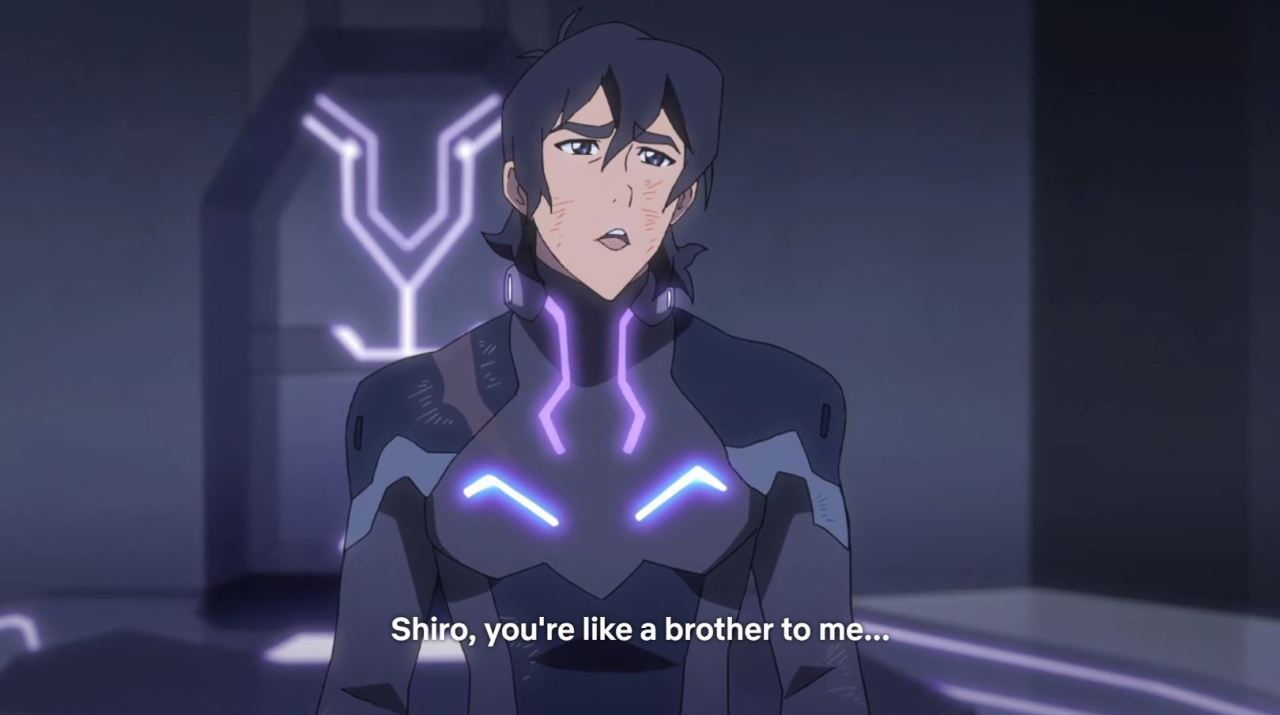
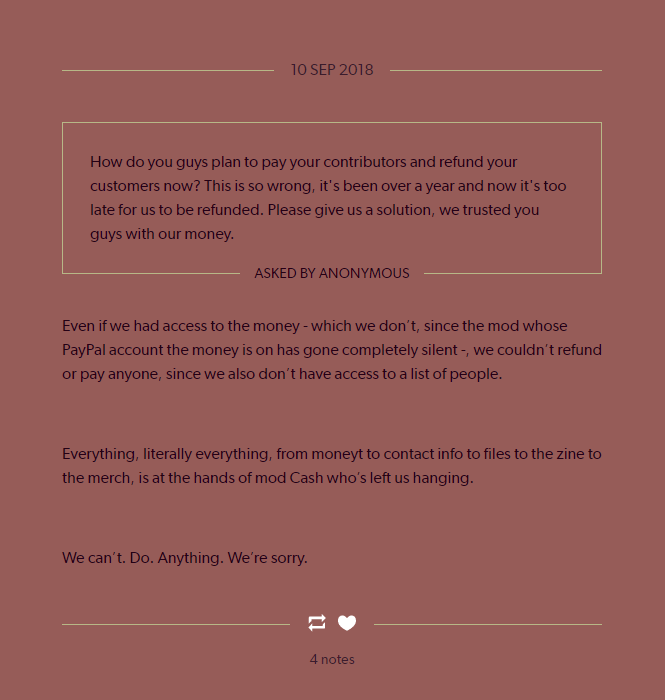


 Elliott Dunstan