This is almost unheard of from me, but I wrote this as a 2020 Christmas Eve shortpretty much on a whim. This takes place (sort of) in the Alkimia Fables canon, and features characters from Ghosts in Quicksilver, just after the projected end of the book. It’s not entirely canon, but close enough.
TW: alcohol use (not alcoholism, but not entirely healthy easier), past child death, past drug use, past homelessness, queer community issues discussed in abstract incl. in-community deaths. Surprisingly, it is less dark than this would make it sound, although it is referencing VERY dark content within GIQ itself.
It was Christmas Eve, and Willow Moray – as had become a deeply unfortunate and not altogether unexpected custom – was drunk off her ass.
To be fair, there were worse drunks out there. She’d lived with one, for starters; and that was before you counted the people who were sweet and just really couldn’t hold their liquor. But she’d timed it wrong, and she stared at the darkening sky above her, bad mood worsening as she quickly went from “fun happy tipsy drunk” to – well, the other part.
“Why am I not surprised?” came the comment from behind her.
Will flopped backwards onto the packed snow of the field. “Averyyyy. My hero,” she drawled.
“You’re being sarcastic, but you wear it so well.” Avery walked up to Willow, avoiding the sprawl of her long hair with their snowboots and clearly trying not to snicker. “Isn’t it a little cold?” they asked. They were bundled up against the cold. Not massively; late December hadn’t brought the worst cold yet, but they had a mid-calf jacket on, and a tuque pulled over their locs.
“For what, getting drunk on the curb like a hobo, or the outfit?” Will wriggled a bit on the snow. It was bizarrely comfortable, once you got past the cold. She wasn’t technically on the curb, but it was the principle of the thing.
Avery shook their head, clearly entertained. One of the nice things about being a Sulfur, Will thought, was that she could tell when she was in for a lecture and when her sense of humour was actually working for her. Even if the wry little grin on Avery’s face hadn’t given it away, a smile sneaking onto their face despite themselves, the echoes of their mood behind them were surprisingly warm. “I, personally, wouldn’t be wearing a tank top in below-zero, but you don’t look like you’re dying of frostbite. And at least you have something with you,” they added, although they gave Will’s hoodie a somewhat cautious glance.
“Relax. Frostbite is so last year. Besides, there are so many better ways.”
Avery raised an eyebrow. “…I feel like you take advantage of the fact that I can tell you’re joking.”
“Shamelessly.”
The older person gave up the fight with themself and snickered. They eased themself down into the snow, pulling a face. “Merde. My jeans aren’t going to be happy with me.”
Will gave Avery a long look. She wasn’t prying, even if she’d wanted to. Other Sulfurs were sometimes the best company she could ask for; she could teach other people how to shield their thoughts to some degree, but other Sulfurs were the people best at keeping her out. Intention got through, more or less, but that just eased some of the usual communication barriers and threw up others. But taking away the headache of knowing, or thinking she knew, or trying to predict, what the other person was thinking – it helped.
“I thought you’d be picking up exhausted carolers and overindulging partiers by now,” Will said quietly. “Please don’t tell me you’re skippin’ work on my account.”
“I set my own hours. And I decided I needed a Christmas off.”
“Even though it’s one of your most profitable nights?” Will eased herself up on her elbows, shook some snow out of her hair, and took another sip of the bottle she had in her paper bag. It wasn’t nearly as trashy as she’d managed to make it look; it was one of those strawberry-wine coolers, with probably just as much sugar as ethanol in it.
“By the time I clean the upholstery, it definitely isn’t,” Avery teased, but then a more somber look settled onto their face. Will knew that look. It meant Avery wasn’t having a great night either. Not a bad night – a bad night for Avery meant nobody was going to see hide nor hair of them. It was something Will almost, but didn’t quite understand. No, it was just one of those nights. Much like with her. Not a good night, not an average night – just kind of vaguely, but mundanely gross.
“C’mon. What’s on your mind?” When Avery looked hesitant, Will narrowed her eyes. “You have literally, and I mean literally, hauled me out of the gutter during an OD. If you don’t want to, that’s fine, but you can tell me anything.”
Avery stuck their legs out, still thinking. “I’m just sad, I think.”
… Fair enough. Although, to be honest, Will was so used to terrible things that the concept of “just sad” was a little weird. Will nearly took another sip of wine, then thought about their night so far, sighed internally, and put the cap back on. Fool me once… “Do you know why?”
“I’m not sure. Maybe I just think too much.”
“I mean, this last year has been a shitshow. We lost a lot of people.”
Avery’s lips quirked. “I think that’s kind of what’s on my mind. Not – really the losing, exactly? I mean, sort of that. I don’t know who wouldn’t be bothered by that. But the… ‘we’, I guess.”
Will nodded, kind of following – not completely, but a bit. It was weird. She didn’t think much about the Great Big Idea of community a lot on her own. But everybody around her seemed to – which had everything to do, she grumbled, with the fact that she kept attracting big thinkers. Jamal and Avery and Cassandra. Stupid big-picture thinkers. And now she was thinking about it more. “Alright, so what’s your big take?”
“Not really a big take. I just miss my family.”
Ah. That was simpler than she’d expected. “Your dad’s in Montreal, right? Not so far.”
Avery shrugged. “Not that far. And he means well. But he doesn’t get it, he never will, and I’m okay with that, but my family here is a mess too.”
“Present company included, I imagine.”
“I mean, you have an apartment, you have actual work, and you’re seeing a therapist in the new year-“
“Don’t remind me,” Will groaned, nearly flinging herself back onto the snow. “You had to remind me.”
“-You’re doing better than a lot of people.”
“That sounds fake, but okay.”
Avery snorted. “The fact that you insist on drinking wine from a brown bag in the middle of a field even though you’re not homeless anymore is more of a quirk than anything.”
“I crave my days of freedom.”
“Bullshit,” Avery deadpanned back. They did look a little better already, though.
Will contemplated her navel, chewing on the inside of her cheek. It mostly sounded like Avery was lonely. The other stuff was true, too, but hell, their community wasn’t going to get fixed overnight. The problem with elementals was that half of them were queer, half of them were crazy, all of them were traumatized, and nobody had written any of the old stuff down for the obvious reasons. Or at least, if they had, it wasn’t anywhere obvious. Avery was chewing at the same bit that they’d been chewing at for a long time, just with more stuff to worry about – they just didn’t have anybody to break them out of the cycle.
Which, Will reflected, was something she could fix. It wasn’t that Avery didn’t have friends. But Avery’s other friends weren’t Sulfurs. They were elementals, sure, but if Avery said they were fine, it was accepted, or at worst prodded at once or twice. There was, regrettably, an upside to Will’s disaster-zone status being public knowledge. Nobody expected her to be an adult.
“C’mon,” Will said after a moment, hoisting herself out of the snow. “It is…” She checked her phone. “Jesus jumping jackerel christ it is five o’ clock. I hate Canada.”
“…Jesus jumping what?”
“I’m trying to swear less. It’s practice for the therapist. Anyway, come on. At least one store is going to be open.”
Avery raised an eyebrow. “What are we doing?”
Will tried to be flippant – then sighed, grimacing. “I am trying to learn how to be a real person and not a walking… thing of knives and sass. And you need company.”
“That wasn’t an answer.”
“It was, just not a useful one.” Will felt embarrassed now that she had to say it out loud. “…Half of us don’t have anywhere to go for Christmas. Those of us who, you know, bother celebrating it to begin with. And I bet people have thought about doing something for it before, but the thing is, we all suck at planning, and everybody’s too nervous to actually do it. So let’s.”
“Let’s what?”
“Let’s do it. At least for Jamal and Jaylie – and Cass, yeah.” She felt herself wilt a little at the surprised look on Avery’s face. “Oh come on, she lives in a fucking school, who do I look like, Satan?”
Avery eased themself out of the snow. “You know nobody’s going to have any food.”
“Nobody ever has any food. We’ll make it work. Besides, I can –“
Avery shot them an icy glare.
“…It’s Christmas,” Will complained. “What’s a little theft between friends and convenience store clerks?”
“I really hope you paid for that wine.”
“I did,” she grumbled. “I wasn’t going to. And then your voice showed up in my head and made me feel all guilty, you jerk.”
“That’s my girl,” Avery laughed, passing by and ruffling Will’s hair. Will stood there for a moment, scowling after Avery and fixing her hair – and trying to make the flush of pride fade just a little. Maybe Cassie wouldn’t be interested. Maybe Jamal was asleep. Maybe Jaylie was busy with her parents – she actually had a home life, it was just a little patchy at the corners.
But, hell. You never knew until you tried, right? And it was better than drinking wine on her own, trying to make the night pass faster, and missing people who were gone.
Maybe his ghost was still hanging around. Maybe he’d done the smart thing and moved on and left her and Cassie to sort out their own crap. And god knows the “Christmas is for family” thing had been a weapon more than anything comforting, when they’d been a family, when he’d been alive – but he’d loved it anyway. Kids, right?
“Merry Christmas, Alex,” she murmured, feeling just a little stupid as her voice hung in the December air.
Digging into a new poetry book is always kind of like opening a box of chocolates. Either it’ll be a little dull, or – in the best cases – it’s full of treats, all a little different from each other. Chloe N. Clark’s Your Strange Fortune is definitely the latter. It’s also an incredibly haunting book, full of dead monsters, zombies, ghosts, abandoned cities, and a general loneliness that is hard to place, but resonates in a place somewhere deep in your chest.
I will be honest. 2019 is a little bit of a blur to me, and I only got medicated for ADHD in late 2019 after suffering from it – apparently – all my life. So I am very embarrassed to admit that at some point, I got emailed an ARC of this – amazing – book and completely forgot about it. There are many reasons this happens, all of which make me sound terrible and none of which are easy to explain to neurotypical people! But I stumbled upon it while looking through my email and I’m very glad I did. (This is also why, while ‘I received a copy of this in exchange for an honest review’ is technically true…) Clark’s poetry is that type of blank verse that tells you a story while also painting a picture – poetry that almost tricks you into not thinking it’s poetry. There’s also a particularly strong visual element to Clark’s work – breaks in lines, use of space and word length, arrangement, all just as much part of the poetry as the actual work. “Flora and Fauna of the Outer Rings” is a particularly gorgeous and vivid example of this.
The thing that truly stands out to me the most, however, is the speculative element winding through all of these poems. It doesn’t feel even remotely strange or forced to jump from poetry about a chupacabra to an ode to museums about “Earth-that-was”, to songs about the end of the world. It’s all written in rich, gorgeous language – and with the same earnest sincerity that sells that these are all topics of the same import and worthiness. It’s lovely to read about topics that speak to the dreamer in me, not just the hurt, with just as much literary flair as more “serious” topics.
Chloe N. Clark’s ‘Your Strange Fortune’ is published by Vegetarian Alcoholic Press – get a copy!
TW: This book and review deals heavily with mental illness, hallucinations/delusions, and the claustrophobia of deep cave exploration.
It’s part of the nature of the literary world, at this point, that I will hear something About a book and how it’s good and still know very little about it. Perhaps, like with Every Heart a Doorway, the only thing I actually know going in is the vague premise and that it has ace rep. Perhaps I know even less than that – Magic for Liars took me so off guard because I knew almost nothing, and I went into Gingerbread and White is for Witching entirely blind. Rarely, I actually know something about the setup of the book, like with Ninth House or Mexican Gothic – but I like being surprised.
The Luminous Dead is a book I heard from ‘best-of’ lists and recommendations from people I hold in high esteem, but I was still nervous to go in. All I knew about it was that it was science fiction-horror, and that there was something about caves. So I am extremely glad to report that one, it is queer; two, it is one of the most terrifying books I’ve ever read; and three, it’s one of the books in the latter half of this year breaking a very, very disappointing streak in which I would pick up a highly-recced book, hit major ableism or something similar a while in, and put it down quite miserably.
So, the basics. Somewhere in the far future, in a setting with terra-formed (but not too terra-formed) planets and colonies, Cassandra-V is a particularly miserable place to live. The mines twisting through the planet offer wonderful resources, but the mines themselves are incredibly deep and dangerous, necessitating months-long expeditions by solo divers to avoid attracting the local wildlife. Gyre Price is particularly keen to get away from Casssandra-V, so she lies about her credentials, and takes on an incredibly dangerous diving job that she’s sure she can pull off. Probably. Downside: Solo cavers are supposed to have a full team of techs helping run their high-tech suit; the suit that feeds them, drugs them, keeps them safe from whatever’s in the air or the water, and holds all their supplies. Gyre, instead, has a single woman on the comms with her – Em, the financier of this peculiar job. As it turns out, Em is not quite stable. Luckily, neither is Gyre.
A lot of books with this premise would have gone for the easy chills; ‘stuck with the psycho’ feelings, tired tropes about mental health, insults about narcissism or psychopathy that would have had me throwing the book (metaphorically; it was on Kindle) across the room. But what makes The Luminous Dead so bloody excellent is that for all that Em and Gyre are both crazy, it’s a sympathetic narrative to both of them. It’s a book written about insanity that doesn’t treat insanity as a spectacle for able-minded people to goggle and stare at; it’s horror that treats mental illness as the most terrifying for those inside of it. I cannot and will not make any judgements or statements about Starling, but I’m deeply impressed to find a horror writer that doesn’t seem more preoccupied with creating a ‘horror movie villain’ than tapping into the psyche of her characters. As a result, the cave, Gyre’s body, and the unravelling mental states of both Em and Gyre all reflect each other. Gyre gets more and more injured and less and less sane as the book goes on, mind and body influencing each other, and the deeper she goes into the caves, the deeper she falls into irrationality. I’m also struck by the commentary on co-dependence – it’s hard not to feel for both Em and Gyre as they’re attracted to each other, while being brutally aware that the attraction isn’t healthy. Will it last outside of a situation where they are each other’s lifelines? It’s unclear – and that lack of clarity is part of the whole book. Are you going up or down? Is this real or false? Is the person you trust lying to you or not? Are you sick or are you insane? Are you dying or are you surviving?
I’ve tried to avoid outright spoilers, but I don’t think I can recommend this book any more highly. I kept waiting for a punchline, almost; something that would show Em clearly as a Crazy Villain and Gyre as an Innocent Victim. Instead, at every turn, I was surprised for the better, and yet, never quite thrown off by something out of left turn. Highly recommend, and kind of wishing I had something higher than a 5/5 to give.
Every day—every fucking day—for the last. How long? How goddamn long? I was putting out fires, and when I wasn’t putting out fires, I was causing them by mistake, or untangling social situations I’d had no part in creating, or making sure my own mind wasn’t unravelling—
Choose, Jamal. Now.
Was it worth letting this happen? I didn’t done enough to protect Jaylie from Kiera before. But…
Jaylie was coming here on purpose. I assumed Jo had told her. Them. It was all of them, if Sunvay sounded that determined. And I wasn’t stupid—Jaylie had been scared, sure. Young, barely any older than me, with the same surly teenage attitude covering up real insecurity. I’d been inside her head.
That didn’t change the fact that she was all the scariest parts of Will’s and Kiera’s powers put together. Maybe not as powerful, but did I want to test that?
Kiera hadn’t answered the question. She’d answered lots of my questions, but not the one I was the most concerned about. Could a bullet hurt her? She didn’t like iron and silver, but could other things kill her? Did she have a real reason to be scared?
Too many questions. Too much anxiety.
“Jamal, what are you hiding?”
Shit. Shit, shit, shit, I wasn’t the only one who could read people. And I couldn’t keep stalling.
“Jaylie’s coming here,” I exhaled. I didn’t even think about it, as a sick feeling roiled in my stomach. “You need to go. Now.”
“I need to leave? What are you on about?”
The world lurched—ever so slightly. Enough to throw me off balance, and enough to tell me the truth. I didn’t fix her nearly as much as she thought I did. She—
What do you see? I can’t see it.
Maybe if I pretended—
“Do you actually know anything about Jaylie?” I said, trying to keep my balance as the room started to spin. It could just be the anxiety, I told myself. That was possible. “She’s never actually stood her ground against you before.”
“Because she’s a coward.”
“She’s eighteen, dumbass. And Black. Fighting back against white people usually gets us shot.” I didn’t usually say us. But whatever, it applied to me too.
The confusion that crossed her face at that was real, or at least it looked real. I could cross that off the list of things to hold against her, at least; wherever she’d spent her life before here, it hadn’t had cops. “It does?”
“…Damn it, you’re even old enough I don’t think I can get mad at you for that.” I was thinking about getting mad anyway, because fuck that, but my head hurt too much. Stay balanced, I told myself. Let her think you’re actually helping. Why? Good question.
So she doesn’t kill you.
And then what? She stuck around forever? My job became keeping her sane? If I wanted to tie my life to a crazy white girl I had safer options.
“She’s not going to beat me in a fight,” Kiera snorted. “She’s just some prissy little bitch—”
“Why do you hate her so much?”
She clammed up again.
“You—” I managed to look away from the walls, which had decided to turn a pulsing, neon green. I preferred the less headache-inducing visions. “You really, really have got to leave.”
“Fine. Come with me.”
“I can’t. This is my house—”
“Come with me.”
“I can’t!”
Then Kiera looked at me, her expression sinking. Her eyes searched my face, looking for something—what, exactly, I didn’t know. Probably confirmation of what she suspected. “It’s happening again, isn’t it?”
I’d felt for her before—the kind of compassion that came from drawn parallels, mixed with fear. The kind of feeling that came from looking at somebody else and realizing that they were a worst-case scenario, a bad end version of you. But the look on her face at that moment was something else entirely; an exhausted, disappointed heartbreak. I recognized it not just because I felt like I could be her, but because it made sense. For a moment, she’d thought she could interact with someone without making them sick, without trapping them in a nightmare world that she couldn’t even see—and I’d tried. I genuinely had tried—
Had I?
I wasn’t tired. Well, I was. I wasn’t any more tired than I had been before she’d shown up. But the drain I’d felt before—
I won’t let you. She’d said she wouldn’t let me, back at the McDonald’s. She wouldn’t let me help.
Did she even remember she’d said that?
Something was still wrong. I was still missing something.
“Kiera—”
She shoved me aside, and I hit the wall so hard it hurt. So much for compassion. That was going to bruise.
I sat up, wincing as I watched the walls of my apartment collapse into what looked like space. It was a wonder Kiera’s trippy LSD shit didn’t screw with me more than it did—I was just thankful it didn’t mess with my sense of touch.
Right.
I closed my eyes. That was better. I could feel where I was, the hardwood floor under my fingers—I really needed to sweep from the way the crud on the ground felt, yikes. Focus. Floor. Wall.
They were going to end up killing each other. Nobody else in the way. Nathan was off with Will, and I could tell he wasn’t back yet. I could even text him to keep his distance until they were done. Will had gotten herself out of the way, and… I could just leave them to it. If I wanted. It was an option, this time, wasn’t it?
I wasn’t sure if she’d ever really vanished, but Jo’s voice returned, continuing the work of grounding me. “If you need to get out of here, I’ll help how I can. I’m not happy about Sunvay risking himself—themselves? But I’m tired of everybody leaving this up to you.”
Why did I keep ending up back here? Not here with my back against the wall, although that was…also accurate. But back here, getting ready to stick my head between one person and another, whether it was a sword and some lost kid, or an ex with a gun and the person who probably deserved it. Isaiah had tried to give me an out; I’d ended up throwing myself back into it. And Gurjas had kept trying to give me an out and I’d practically bullied him into telling me the truth.
How was that for a realization? The little me had told me you can’t stop and I’d thought it was a pattern of addiction and helplessness. I wouldn’t stop.
I opened my eyes, squinting against the bright white of the void that the pulsing illusions had turned into. Jo was sitting in the middle, hovering gently above what should have been the ground and casting a dark drop-shadow that she had no substance to go with. “…Are you actually here or is this more mindfuckery?”
“Actually here, yeah,” she said quietly. “I can help you get out—she can’t really affect me as much, so I’m okay.”
I focused on her, slowly managing to orient myself. The visions were different this time, and I wasn’t sure why. Less… consistent, I supposed? Usually it was a worsening descent into madness and chaos, with some sort of theme underlying it. This time, it felt like being dropped into a broken TV. “It’s—not like this with most unstable Mercuries, is it?”
“Isaiah says it isn’t. Or not—I don’t know. He says there’s not a lot of Mercuries around anyway, or that they stay pretty quiet—but this is pretty unusual.” She hesitated. “It, um—it means she’s been like this for a long time.”
I nodded quietly. “Like if I’d been stuck in the Medium when I was unstable. Just—left there.”
“I guess? I don’t really—” She glanced at the window. “We should go.”
“I’m not sure I should.”
“Jamal, you’ve done enough. Jaylie knows wh—well, they know what they’re doing. Collectively. I’m not actually sure how many of them there are.” She uncrossed her legs, standing in front of me with the same worried, frustrated expression I was so used to. “What on earth do you even want to do? She doesn’t love you, you know that.”
“That’s not—” I laughed despite myself. “Jesus christ, Jo, I thought you knew me better than that.”
She went a little pink.
“Of course she doesn’t love me. But she’s sick. That’s what the whole unstable thing is about—that’s what Will told me from the start. She’s sick, and she needs help.”
“So let somebody else do it. It doesn’t have to be you. I don’t care about what people say, Ottawa isn’t the whole world, there’s other Salts, and she isn’t even human, she’s a faerie—” Jo buried her face in her hands in frustration, quiet scream muffled in her hands. “When I wanted you to help people this isn’t what I meant!”
I could have responded to that—maybe I should have. Whether or not she was human didn’t matter, even if I knew what Jo meant. And sure, I could let somebody else do it. There was probably somebody else. Will was trying, Jaylie was trying—
I just didn’t want to.
I got to my feet, reminding myself that even if it didn’t look like I was standing on a solid floor, I could feel it. Then I gave Jo a smile, wishing for all the world I could squeeze her hand, or hug her. Anything. “Love you.”
“Jamal, don’t you DARE—”
I went down the stairs after Kiera, and threw open the door. She was standing there in wait—but not for me.
Somebody was coming down the glistening, rain-soaked street, the still-small snowbanks on either side of the narrow way framing them and the late-afternoon sun stretching their shadow long and thin in front of them. They were walking directly down the center, with—I swallowed. They were holding a baseball bat in their hand, loosely but clearly displayed.
“Took you long enough,” Kiera sneered. She didn’t even have her sword out, her hands tucked into her pockets.
Sunvay raised his head, the chalk-white patterns across the bridge of his dark nose and brows all the more striking in the dusklight. Then he lifted the baseball bat, resting it over his shoulders and his six fingers drumming a pattern on the handle. “You want a fight that badly, banshee? I’ll give you a fucking fight.”
Fandom is a topic I return to again and again; as somebody who grew up whetting my authorial teeth on fanfiction, analyzing my favourite FMA characters and (embarrassingly) LARPing the Pevensies in the elementary school playground, it’s impossible to avoid the ever-present role it has in my life. Even as an adult trying to build a career, it intersects with my career again and again. Anti-queer and censorship attempts affect both my fan work and my professional work; my skills as a beta reader are pressed into service again as an editor; it goes on. However, over the last ten or so years, there’s been a rising force in fandom that’s made me deeply uncomfortable, precisely because of my dual nature as a fan writer and a professional author. I’m both just somebody screwing around and having fun, and somebody trying to make this a career. I can be both; but I can’t operate somewhere in the middle and claim it’s both at the same time.
This is precisely what has been plaguing fandom for about a decade now. Fandom is stereotyped, not that unfairly, as the pursuit of the amateur. You “do” fandom because you love whatever you’re involved with so much that you want to dive into it. A fan writer creates what they do because they think it’s fun. A fan artist draws their favourite ship because it’s theirs. The word amateur itself means “a lover of something” – not that you’re bad or unskilled at something! However, increasingly, there’s a push to be professional in fan spaces, which wouldn’t be so bad if it was consistent, fairly applied, or had any actual passing similarity to real creative professionalism. Instead, it’s a Frankensteined, vague concept of professionalism that too often dips right back into amateur/fanspace politics – often when deeply inappropriate. I’m not saying, of course, that “real” creative professionals always get it right, especially in a modern social media context. It’s a frequent issue that authors or comic artists with thousands of followers unthinkingly or maliciously quote-retweet somebody small or take some criticism more to heart than they should. Even Lizzo, who I adore and would probably do literally anything for, tweeted angrily about a food courier “stealing her food” and forgot, for a moment, that she’s a global superstar who absolutely has fans awful enough to track the poor courier down. (She did pretty swiftly apologize for this one, which is why I’m pretty comfortable saying she just forgot. I would too!) But within the professional creative world(s), there are certain standards already in place, and when those standards are broken, violated or in need of updating, it’s a conversation that can take place on steady ground. The ongoing discussion about video game studios and “crunch culture” is one of these (see criticisms of Telltale Games and CD Projekt Red) , as well as other industries like publishing’s refusal to hire outside of New York City and Hollywood’s fraudulent accounting practices.
Fandom, on the other hand, has been kept in the shadows until extremely recently. It was embarrassing and possibly career-ending to admit that you wrote fanfiction, especially since it was all obviously just “gay smut” – so fandom forums were all pseudonymic, online-only, and ephemeral in the sense that if somebody left, they were just Gone Forever. If you truly became close friends with somebody, you might share personal information, but it certainly wasn’t expected. Fan artists had a touch more confidence, since even prior to this shift it was acceptable to sell fanart at conventions, but the stigma of fandom didn’t start lifting until – well, really, until AO3 was launched in 2009 and started becoming massive. Archive of Our Own’s role in professionalizing fandom can’t be understated; the Organization for Transformative Works includes a wiki for fan history, a peer-reviewed academic journal, legal advocacy for fans to defend fair use and the right for transformative work to exist, and active preservation of older fan archives in risk of shutting down, fan zines, etc. It’s the kind of project that treats fandom as a serious, worthy pursuit, and it’s not for no reason it won a Hugo Award for its organizational structure, coding and tagging.
Fanzines and Elitist Culture
Telling people in fandom that they’re not airheads for enjoying their hobby is a massive thing, and – to be clear – a good thing. But it’s not going to be without consequences. It’s a little while after the founding of AO3, for example, that fanzines start making a comeback. Historically, fanzines were small, handmade things shipped out by mail and either barely breaking even or at a loss.
“Perhaps the first media fandom type publication was The Baker Street Journal, about Sherlock Holmes, which dates back to 1946. Lennon Lyrics, the official John Lennon fan club zine from 1965 to 1968, carried factual material about John’s work with the Beatles and independently. The earliest Star Trek fanzines had a similar format… Early on, typewritten submissions were mailed back and forth between contributors… and editors, and then the final versions copied on mimeo machines (and later photocopiers) and physically collated into zines for binding.”
The revived version of fanzines were, predictably, largely electronic. However, due to the changes in the world of printing, binding, etc. they’ve become much more elegant affairs – sometimes full-size, sometimes “digest”, and often even full-color. Additionally, due to how fandom changed, they became vehicles for fanfiction and fanart almost exclusively, at least in the large cartoon/anime fandoms. What does this mean? It means that opposed to other fandom events (fic/art exchanges, “big bangs” which are essentially fic-writing and collab races, open-submission themed weeks, etc.) zines have an actual submission process. Printing costs limit the number of people who can be featured, and submission forms for zines range in complexity from simply sharing an idea you have, to giving references and sharing previous work, to actually listing previous zines you’ve in. While I’m not sure if it started in this fandom. Voltron: Legendary Defender was so over-saturated with zines that between “invited contributors” (well-known artists and writers) and repeated guests, there was a steadily-growing gap between People Good Enough For Zines, and Everybody Else. How could it be avoided, when zines need to be purchased, there’s limited money and space to go around, and you want only the best of the best?
This has a toxic effect on writers and artists; instead of creating what they want to and what they love, there’s increasing pressure to make what will “sell”. Perhaps not in the traditional sense – but first, you have to “sell” the idea to a zine mod (and as several people have brought up, hope that it also doesn’t get stolen), and then you have to write/draw it in a way that will “sell” the zine – sometimes for profit, sometimes to support a charity, but either way, to bolster your brand. And supporting your brand means more commissions, or more zine invites, or more Redbubble purchases. You want to be in zines, because you want exposure, but if you want that exposure, you have to write the right ships, and in the right ways, and impress the right people. And it has a toxic effect on fandom consumers because – quite aside from the fact that there’s a much more rigid line between consumers and creators in fandom than there used to be – there’s suddenly an Elite Class of fandom creators. Sure, you write fanfiction, but do you write good fanfiction? And if you write bad fanfiction, what’s the point? This leaks into big bangs and exchanges too; if you don’t get a “good” gift, then you feel let down, even though somebody put work into it! And if you don’t have “good” art, why claim or post for big bangs?
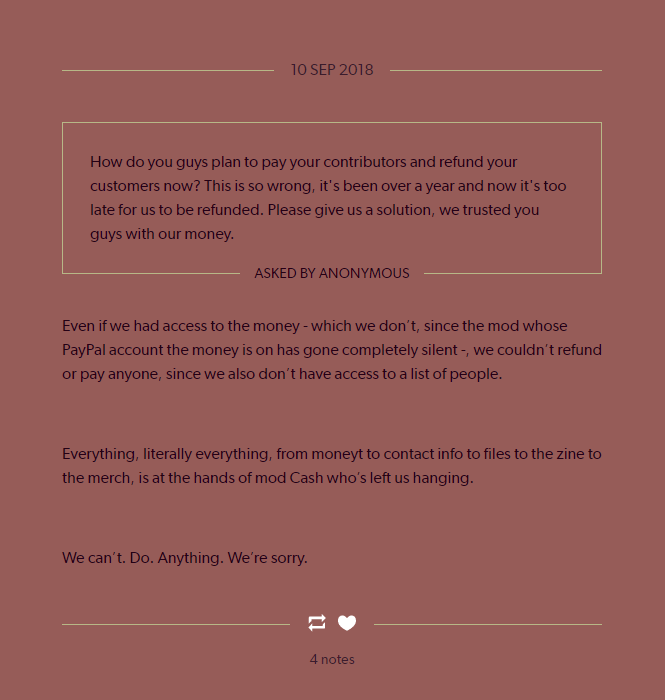
Clearly, the main issue with this is capitalism. It’s hard to avoid the need to monetize hobbies when the economy is crap and people need money to live. But if any of these were treated professionally, perhaps it would feel less overwhelming. Zines create a certain degree of elitism on their own, but the elitism wouldn’t sting so badly if there weren’t so many examples of zines simply stealing money. Consider Eternal Eclipse, a beautiful horror zine for the Voltron fandom, that after some time of radio silence, announced that one of their mods had simply disappeared.
A sample ask from the Eternal Eclipse zine blog (darkvoltronzine), after announcing with extreme embarrassment that they’d been left hanging – along with everybody else.
(For those who want further context; here is the Wayback Machine link to the blog; the Tumblr blog is still up but has mysteriously deleted a number of these posts. Whether or not that means the zines were shipped out is unclear, but given that as a contributor I never received a copy or an email, I’m highly doubtful.)
This is far from a one-off. Stories about zines that never shipped, shipped after years in hiatus, emotional abuse and exploitation on mod teams, issues with credit and payment, randomly kicking contributors over ship discourse, and worse abound.
“Bungou Stray Dogs Fandom: The zine, which was for free, took over a year to published after completion. During this time, mods ghosted the entire server for months and when they did review our work, couldn’t give any good criticism. Additionally I had the massive issue of the writer mod critiquing my grammar and punctuation according to the american grammar style despite me repeatedly reminding them that I Am Not American. There was also the issue of getting these critiques a literal day before the supposed “deadline” in the middle of exams. Followed by more ghosting.”
Anonymous contributor (from the English-speaking Caribbean)
“I was one of the editors of the Shidge [Shiro x Pidge] Zine. The head editor was really difficult to work with. They demanded a lot of my time and effort and acted as though this zine should be my first priority, even though I made it clear to them that making it through my senior year of college was my top priority, and that also included relevant extracurricular activities. So when I didn’t show up to a meeting or discussion after saying upfront that I’d have to leave early or something came up, the head editor would chew me out. They would attack my ADD and say things like it’d be a miracle if someone hired me because of my lack of organizational skills. (After the problems piled up)…the rest of the editors banded together and made a post on tumblr where we warned everyone in the shidge community about the head editor’s behavior. (…) Unfortunately, the head editor basically held the zine hostage for two years, and it got to the point where I called them and told them that they needed to ship things out. (… )That seemed to be effective enough to get the zines people had been waiting 2 very, very long years for.”
d0g-bless
And even beyond that, issues with professional boundaries persist; while the concept of a Shiro Pin-Up Zine is perfectly fine, a contributor took it upon themselves to give a copy to Josh Keaton (Shiro’s voice actor) publicly at a panel.
The question is, where is the accountability? Because fandom is still so used to anonymity as a reasonable expectation, and it’s much harder to track a username than it is a legal identity, the same mods often crop up over and over again. Additionally, because many people are not participating both in fandom and professional lit journals at the same time – or certainly not with this intensity – it doesn’t occur to the vast majority of fans that this isn’t business as normal. Sure, it sucks to have your money stolen. But for the nineteen-year-old Jojo’s Bizarre Adventure megafan, it’s not immediately obvious that zine purchases aren’t supposed to be a Russian Roulette, and that people running them aren’t supposed to make you feel awful. Lit journals and magazines aren’t immune to this, but sites like Writer Beware exist precisely to warn writers of the bad ones. There’s also the unfortunate effect that the more accountable somebody makes themselves, the more the unreasonable accusations will stick to them (e.g. “they’re a predator because they ship this”, “they were mean about this fandom thing”) which, once again, makes anonymity desirable. The toxic people deliberately keep themselves untrackable; the ones with good intentions are honest and look worse by comparison.
Finally, of course, there’s the unavoidable detail that zines are not legal. You can’t enforce anything legally against bad zine mods when zines see the grey area that fanfiction and fanart (not for profit) exist in and zoom right past it. Charity zines just about manage fair use, but that’s about it. And this brings us to the role of money in fandom’s professionalism problem…
Merch, Copyright and Getting That Cash
Above, I talked about how fandom content creators are pressured into creating a “brand”, and that’s a big reason why zines create “standards” for fandom, even passively. But when it comes to zines, brands and cash, there’s another massive factor: merch.
Merch exists in the same area as zines: it really, really isn’t legal. No two ways about it. Fanfiction and fanart are legal because no money is being made off of them. Commissions, while debatable, have an argument for legality because you’re paying for the service of the creation of a then-free item – but merch is allowed to exist simply because of the tolerance of the copyright holder. (Of course, I say ‘no two ways’, but both the nature of fanfiction within copyright and the ethics of copyright law itself are hotly debated. Strikethrough was largely targeted at sexual content, but also hit at fanfiction conceptually, and the current lawsuit against the Internet Archive, while reasonable in and of itself, ignited discussion about what the parameters of copyright should and shouldn’t be.)
One thing that was an important point in the Internet Archive discussion is also relevant here; copyright may be unethical in a perfect world, but violating it impacts smaller creators the most. Most large fandoms are for corporate media, so this isn’t an issue. Voltron: Legendary Defender and She-Ra: Princess of Power aren’t in particular danger from people posting fanart to Redbubble or making keychains (especially since VLD, notoriously, had terrible official merch). But once you get into book or video game fandoms, the game changes. Holly Black, author of young adult literature such as The Cruel Prince and The Spiderwick Chronicles, became the subject of immense backlash just over a year ago when she announced that she would be teaming up with Topatoco for merchandise, and protecting her copyright. Prior to this, like most YA authors, she had been ridiculously permissive about people making money from what was essentially her property – many took it as a betrayal, while others were confused why it hadn’t happened sooner. It’s important to qualify here that authors do not make a lot of money; even successful ones like Holly Black or Seanan McGuire are comfortable at best.
The same issue arose recently with fandoms for indie video games Hades and Among Us; polite requests not to make merch for the games have been ignored or taken as insults. However, when Supergiant Games (creator of Hades) did release a merch policy that allowed merchandise to be made, it became clear that there was a distinct gap between those with professional experience, and fans who hadn’t learned those terms – mostly over the term ‘handmade’.
“Basically handmade is stuff produced by you, specifically, and mass-produced is something you’ve contracted out to a manufacturer, even if not in massive quantities. Me printing giclee prints with my own printer is handmade, me outsourcing giclee prints to Inprnt is mass-produced. The reason this is significant from the company’s perspective is scale potential. There’s only so much you can manage on your own, even if you have professional tools, whereas manufacturers have significantly larger production capabilities.”
Aleta Pérez
It wasn’t clear to many fans that home printers would still count as handmade, for example – and because of fan norms about professional vs. amateur work and considering “professional” creators as the enemy, corrections weren’t taken as well as they should be.
Ultimately, fan merch is always going to exist; but merch creators exist in the same pseudo-pro bubble as zine makers. They’re well aware of the stigma that it’s “just” fan stuff, and operate under that mentality, but are still selling a product and operating within a professional industry. And because purchasers of said fan merch are frequently (depending on the merch and fandom) equally unaware of the norms of the industry, a lot slides by that shouldn’t. Somebody selling, say, apple butter at a farmer’s market has to learn how that market works, and the norms of behaviour and product expected from that industry – but fan merch often sidesteps the normal ways of entry, with bizarre consequences.
So already with these two examples, it’s clear that as money, brand, and “real life” intrude more and more on fandom, the threads of professionalism and amateurism tangle in ways that cause inevitable hurt. You can be everybody’s friend and run a cool awesome fan event where everything is fun and low-stakes, or you can create something to high standards that you’re selling for money; but trying to do both is going to get people hurt. If nothing else, DashCon should have taught that lesson.
Fanexus, Cults of Personality and Fandom vs. Business
All of these are frustrating, of course, but so far, none of these have intruded into the unexpected for fandom. Spending money on badly-considered fan-ventures is practically a rite of passage, even if it’s more common than it used to be. But now we come to the issue that actually motivated this article. What do you do when somebody attempts a start-up company and runs it with the same dynamics, motivations and in-fighting politics as fandom, and nobody sees an issue with it?
Fanexus, as described on its own site and by Fanlore, is an “upcoming fandom-focused platform”. It’s modeled after other social media sites, probably the most notably Tumblr, but with cues from Pillowfort, Dreamwidth and other fandom-focused platforms. Most importantly, Fanexus seeks to be a social media site that is completely anti-bullying; that is, anti-shippers and other censor-happy members of fandom would straight up not be welcomed. Twitter, infamously, does not take reports of brigading seriously, and is just as likely to temporarily suspend somebody accused of pedophilia for completely chaste drawings of a frog and a princess as they are to even reprimand a TERF for consistent misgendering and death threats. Obviously, the “pro-shipper” contingent of fandom has celebrated and eagerly awaited this ever since it was announced, the flames only fanned by Tumblr’s infamous porn ban. (Pro-shipper, pro-fiction and anti-censorship are labels that, in fandom, largely refer to the same or similar things; a refusal of the “anti-shipper” perspective that says ships and characters should reach some moral standard, and that fiction should be held to the same ethical bar as real life.) In the months since, Fanexus’s mystique has only increased, with proshippers even half-joking that they’re counting down the days until the beta launch, joining the discord server, and drawing lewd art of a personification of the site as a tongue-in-cheek promo.
However, from early on, Fanexus has been plagued with controversy. Their close allyship with the deeply controversial Prostasia Foundation has inspired criticism, as well as its stance on “MAPs” (Minor Attracted People). The actual nature of the debate pales in comparison to Fanexus’s actual handling of the question; people who questioned the decisions of the mods were put publicly on blast for months on end, and are still facing blowback.
“I raised concerns in early august about Tox’s past and what that meant for Fanexus, which resulted in severe harassment from Tox and his supporters, and… I was given incorrect labels (such as “anti”) in an attempt to discredit me. When that didn’t work, I received death threats, and Tox even aided one avid supporter who had attempted to doxx me.”
-BoomerSlayr9000
Nor was this an isolated incident that could be blamed on the difficulty of any discussion about pedophilia and mental illness. The thread from @euladarnus below chronicles another example of unprofessional behaviour from Fanexus mods in early October.
[“Fanexus’ dedication to fostering a safe community on their platform has been so successful as to make me feel UNsafe on THIS one. The fact people REPORTED MY POSTS & a head mod feels comfortable insinuating “we have people everywhere” like some sort of veiled threat? love it”
“the chain of events, to be clear: i said i was uncomfortable with a social media platform requiring an application where your other [social media] is checked for approved content & had ethical concerns. somebody reported me to the mod. mod replies to ~~explain the vetting process…
…and I block because it’s not worth trying to explain at 5am that my issue is with the fact that a vetting process exists at all as opposed to banning harassers after they’ve actually done something. the mod complains about me blocking, and then continues publicly ranting about…
…how fanexus wants critique, just not…critique their mods dislike, apparently. ok. cool.
let me clear. i said on my personal twitter, with no names used, that i was uncomfortable and would not use the platform unless changes were made because of my personal ethical concerns. i also made clear that i have no issue with people who don’t find this personally concerning…
…or who do but prefer to use the platform anyway because of whatever reasons, and that i simply did not feel comfortable with this approach and so would not personally use it. and instead of whoever personally follows me who is a mod DMing me to address those concerns privately, it was…
…sent to a head mod, to be responded to publicly… “put on blast”, i believe the kids say these days lol (and completely missing the point of my criticism in the process) then complaining when i blocked to disengage.
not handled well, guys.
anyway, feel free to unfollow, soft- or hard-block me at your leisure. i’m really fucking uncomfortable with this and i wish that it had been dealt with with even a shred more maturity than the mods have shown.
it’s 6am and i’m gonna go make myself some tea now.”]
The thread is included with permission and linked to the thread on @euladarnus’s twitter. Several weeks after this encounter, she received a message claiming that the mod who had harassed her had been dismissed from the team – however, the mod dismissed was not the one who had harassed @euladarnus, but instead, the mod who later came out with stories about being abused and scapegoated by the rest of Fanexus’s mod team. And even quite aside from that situation, the public tweets from the mod actually responsible at the time are deeply unprofessional and concerning on a number of levels.
[“For the record, I’m not trawling the fanexus tag for posts. i’m being linked these posts by mods who are following the posters. turns out we have staff from all reaches of fandom!
‘but why are you they linking these posts’ because i’m Fanexus Tough Love Daddy and i usually take this sort of task upon myself”]
“i’m appalled by the lack of professionalism from the mod team… at the end of the day, i simply don’t trust a group of people who seem to engage in online harassment as a hobby to moderate a site with the vision of ending online harassment.”
euladarnus
Another concerned onlooker had this to add.
“I have a friend who was one of the mods and one of the other mods started harassing them. The other mods just let it slide, started going after my friend as well or ignoring what was going on, and forced my friend to give up their position due to bullying. If the mods are willing to do that amongst themselves and let that slide, then their site isn’t going to be the safe haven they claim it will be. I’ve been on Twitter long enough to know that if thats how they’re acting I’d be safer on here.”
Anonymous Contributor
And yet another was willing and ready to share information from the discord, but was too scared to reveal their identity to me directly – terrified of reprisal from the Fanexus mods themselves. This hasn’t stopped multiple other people from sharing screenshots and experiences in the Fanexus tag – from calls for accountability in the discord itself to mods not being clearly identified as mods.
Yet this hasn’t stopped many from brushing this off as “drama”, pettiness or unnecessary fighting. Fandom, after all, has no shortage of callouts, complete with screenshots, tagging, and taking sides. Why is this different? Well, here’s a clip from Fanexus’s FAQ:
“Right now the beta is being paid for by the founders. Once the beta is online and in use, we plan to have a Kickstarter to fund the development of additional features we couldn’t afford to include in the beta. Fanexus will be freemium, which means it will be free to use, with premium features such as added customisation, that will be used for the ongoing funding of the site.”
To be clear, there’s nothing wrong with this model – nor is there anything wrong with a beta being paid for by its founders. Most start-ups run this way. It’s expensive to start a business, and it’s like gambling. You sink a bunch of money into it and you hope it works out in your favour. But the key word here is business. Unpaid or paid, free to use or premium, Fanexus is stating an intent to work as a business. They’re putting money into their beta with a hope that they’ll be getting it back. No websites are free; Archive of Our Own, Wikipedia and Gutenberg are constantly running fundraisers, and Twitter, Tumblr and Facebook advertise to their users in order to cover their costs. Discovering the source of funding for any social media or website is a crucial part of understanding its intentions; if a site doesn’t have advertising, it’s getting its money from somewhere, and you have to be able to trust that funding. And already, this sets Fanexus well apart from a forum on Gaia Online or a group on Livejournal; these aren’t mods of a casual fandom event. These are founders and shareholders of a business. Ultimately, too, language matters; the insistence of the founders in calling themselves “mods” and putting all “mods” on the same level (it’s actually unclear exactly how many mods there are) disguises how many of the mods have provided funding from their own pockets to get the site going, and how many are expecting eventual reimbursement of that funding in time. In addition, while it’s possible that all of the founders are providing equal amounts, even equal amounts of money will affect different people in different ways; so who is providing the bulk of the funding? Is one of the mods working from a trust fund while another is struggling with two jobs? Again, it’s unclear, and shouldn’t be.
Immediately, once Fanexus is reframed from a fandom forum to a business with shareholders and funding, a lot of the behaviour they display becomes more suspect. It’s hard not to remember, for example, the chilling anecdote about Cards Against Humanity putting their single Black employee in the psych ward for speaking up against racism. It also becomes less useful to ask why fandom can’t rise to the standards of professionalism of the non-fandom world, and more useful to ask why unprofessionalism and workplace abuse, when it happens, isn’t treated the same way. After all, when you really think about those big bangs and volunteer-run boards, exchanges, fandom discords… that’s an awful lot of volunteer work done by people who end up being treated like crap. It shouldn’t take an actual company with money involved to start questioning whether or not this is an okay way to treat people. Even without that, the burnout of unpaid labour is already well-contested in fields like publishing and activism.
It doesn’t stop there, though. The recent callout from an ex-mod shared screenshots from inter-moderator and in-team discussions, without names censored. Immediately, those trying to protect Fanexus – both mods and eager fans – began to bring up privacy concerns. “Couldn’t this have been done in private?” they said, resoundingly, and even without the repeated answer that private intervention had been tried… Is Fanexus a company or not? Is Fanexus accountable or not to a public group of people? Should Fanexus’s mod team be public information or not? It’s a worrying statement to hear that the Discord username of a moderator of a social media website should, somehow, be considered private information – when all hopeful users of this site are currently on the same Discord. It also doesn’t pair well with a tweet linked earlier, that I’ll touch on here again.
Shared with permission from @rooftoprush’s twitter.
[Rooftops: Hello? did i do something wrong?
paris [Mod]: Hello. We wanted to talk to you about a rule violation. A mod attempted to react to the message you were engaging with but clicked yours by mistake and discovered you had blocked them. Please keep in mind that it is against the rules to block mods. Please unblock all moderators you have blocked and note that you may request any mod to not interact with you instead. Any further violations may result in being removed from the beta. Do you have any questions?
Rooftops: okay which mod was trying to ask me a question?
paris [Mod]: It wasn’t that a mod was trying to ask a question but trying to add a react to a message and clicked on your message instead.]
In this Discord screenshot, it’s made clear that people are not supposed to have any mods blocked… and in the linked thread, it’s indicated that Fanexus’s Discord has an excessive amount of moderators, not clearly listed. So essentially, on the Fanexus Discord, you aren’t supposed to block anybody, because they might be a moderator. And you can’t screenshot and share anything without redacting names, because you might be exposing a moderator. And you can’t expose a moderator, because everybody has a right to privacy, even if they’re a moderator for a public business. In short, Fanexus’s practices, no matter how terribly they behave, must stay private at all costs, otherwise the whistleblower is the actual bad person – and their behaviour towards all whistleblowers or even concerned bystanders so far certainly proves this true so far.
So what should be happening? The conversations about capitalism, “emotional labour” (and its divisive, multiple meanings), payment and expectations are ongoing, and a whole entire book in themselves. But when it comes to professionalism in fandom, quite simply, people need to pick one. Either fandom can be just for fun; you write fic and draw art with your friends, you perhaps bat some money back and forth for commissions, you do some silly things to screw around with ideas, but ultimately real life comes first. Or, fandom is a world of events, full websites, hosting, moderation, where people are penalized for missing deadlines, there are mediators for conflict, and products are held to a certain standard. These worlds aren’t even entirely mutually exclusive. The first can exist inside the second; but for the second to exist, it needs to be acknowledged that moderation is a job. Event planning is a job. Graphic design, server hosting, website design – those are all jobs. And even if unpaid, there is a contract involved; treat the people performing those duties with respect and professionalism, and those people will treat you with the same. A moderator for a zine or a website shouldn’t be making decisions based on personal grudges, and if they want to, they should be moderating something not masquerading as a professional product.
The Future of Fandom in a Post-Capitalist World
I’ve mentioned it more than once, but the true tragedy of all this is that it’s a reaction to an outside influence. Young and growing adults terrified for their future monetize the only thing they feel good at; and the gatekeepers of the “professional” versions of these industries won’t give chances to people who haven’t already proved that they’re good at it the Real Way. Most writers can’t afford to finish a book and shop it out three hundred times to “proper” publishers and agents when they have rent to pay – and the still-sneering attitude of many older writers towards fandom keeps people stuck in those bubbles. And when fandom doesn’t yield the money required, people just try harder, because they must just be missing something – forgetting that fandom was never supposed to be about money in the first place.
So what would fandom look like, breaking out of the pseudo-professionalist bubble? Many of our current standards of professionalism, admittedly, need updating (although creative fields have always been better about things like, say, piercings and tattoos). Fandom has just as much to give to the non-fandom world as vice versa; it just has to be willing to have the conversation, and it is starting. A willingness to accept that a fan-run site like AO3 or Fanexus should and is held to the same standards as Wikipedia or Twitter is a good start; while size and good intentions will get you off the hook for a while, it only gets you so far.
However, I think a big part of is also letting go of fear. There’s a sense of a ticking clock hanging over fandom, all the time. Fandom is dying; fandom is in danger; if you don’t write better fanfiction or save this show, or support this ship enough, or promote this or that website, then fandom will die. This is nonsense. Fandom’s existed since Sherlock Holmes, and even before that. Fanexus wasn’t going to save fandom because fandom doesn’t need saving; zines were already a revived version of something fandom already did, and merch copyright isn’t going to kill that desire to create just because you can’t make money off of it. There’s a running thread of fear that if we hold people who act unprofessionally, rudely or straight up abusively in our spaces to account, we’ll lose something important and irreplaceable. It isn’t true. Fandom starts and ends with you, something you love and the question ‘what if’. The rest is commentary; go and learn it.


 Elliott Dunstan