• Home
  • Contact
  • About Me
    • Publications
    • Books
  • Bell, Clock and Candle (Elessa)
    • The Nowhere Bird (Bell, Clock and Candle #1)
  • ALKIMIA FABLES

Elliott Dunstan

  • Home
  • Contact
  • About Me
    • Publications
    • Books
  • Bell, Clock and Candle (Elessa)
    • The Nowhere Bird (Bell, Clock and Candle #1)
  • ALKIMIA FABLES
  • spikes (my eyes see all that I can dream)

    February 29th, 2024

    cw: mental illness

    take your meds, stay out of danger now–
    wake up, sleep, don’t stay up late tonight,
    avoid caffeine, keep your stress levels down,
    cortisol spikes are railway spikes (for you)
    nailed deep into your brain
    nailed deep into your body
    stigmata for the crown of thorns
    that you had sought to burn–
    well, this is how it feels to burn
    to fade away.
    (nothing’s fading really, it’s all just out of reach
    underneath a silky cloak of ashes on my skin–)
    take your meds, stay out of danger now–
    wake up, sleep, and go to bed on time,
    don’t watch the sun rise, rise with it instead
    even this won’t silence the voices in your head,
    but it’ll quiet them some
    leave room for you to breathe.
    (did I eat enough today? why can’t I
    remember? sometimes i am just a machine–)
    you are never a machine.
    you need water to live, you need air to live,
    your muscles need to stretch
    your eyes need to see.
    (my eyes see all that I can dream).
    cortisol spikes are railway spikes
    rusted spikes and heartbeat spikes
    spikes that keep away the monsters
    and the maidens all the same–
    cortisol spikes on sleepless nights
    when all is dark and quiet and lonely
    and you know what the cure is, yet,
    you gaze into the opal screen.
    take your meds, stay out of trouble now,
    the years tick on and habit is routine
    eat, drink, sleep, awaken, know your ritual
    to stop yourself from tearing at the seams.

    (want to support me? find me on ko-fi: https://ko-fi.com/A583QED)

  • Burned Out, Blistered and Brightening /// on a different kind of recovery

    February 27th, 2024

    Today, after two and a half years of not using it, I plugged in my alarm clock. In those two years, it had gotten carted around to three or so different houses, but it was never quite the right set-up. I’m hard of hearing, and my alarm clock shakes not just my pillow but my whole bed; it doesn’t work so well if you’re sleeping on a mattress on the floor, you see, and it’s loud and disruptive enough that I didn’t want to test the hospitality of the man I was staying with before finally getting a real apartment again.

    But it didn’t really need to take me two and a half years. I moved into this place January of last year. It’s a nice enough apartment; a bit small for me and my girlfriend and my extensive library of books. I just never had enough time to even think of it with the long list of tasks that seemed to face me every day — although that’s not really it. When I try to describe the last two and half, three, four years to people I often end up describing it as housing insecurity; if I’m focusing on 2022, I’ll skip the niceties and just say that I was homeless for a while. The moment I say that, some people start picturing me in shelters or on park benches, struggling with drugs or panhandling. (Interestingly, none of these are that far off the mark! They just look different.) But I correct them, if it comes up. I always had somewhere to go, even if I had to ask around. I always had somewhere to sleep, even if it wasn’t comfortable. I never ended up in a shelter, or outside. It wasn’t that bad.

    I’ve been in stable housing for fourteen months. I keep looking in the mirror — at work, at home, at a bar or a queer drop-in or someone else’s house — and going, if it wasn’t that bad, why are you still like this? I pack cans of food in my backpack when I’m stressed. I went on a weird paranoid bender late last year where I started turning my everyday backpack into a survival kit — there’s nothing like wildfire smoke in your lungs to bring out a lot of very, very intense fear of displacement. I know how to dehumidify my hearing aids with a bathroom hand dryer. I’ve always had struggles with the cold on a mental level, but now when I dissociate when walking in the winter, there’s a part of me trying to convince myself that I’ll be out here all night.

    The worst part of all this is that I was only ‘unhoused’ in the true sense for a matter of weeks. I’d have to go back and check the exact duration of time, but I was sleeping on the floor of a friend’s empty apartment for that period. The rest of the time I consider part of my housing instability are more complicated; couch-surfing complete with paying rent, settling into a new place only to be kicked out a few months in (illegally, but there are times to bother with fighting and there are times not to). I’m hesitant even to apply the term homeless or unhoused to many of these experiences, even though ‘hidden homelessness’ is an established term; and when I’ve made acquaintance with people who have lived on the street for years, it feels ridiculous.

    Nevertheless.

    It’s not easy to try describe my burnout to others. For one, it involves trying to describe the situation that put me here in the first place. Two, it requires contextualizing why it would even surprise me that I’m traumatized. I’ve already been through some of the worst that someone can handle, and I already put myself back together. I know what it looks like when I shatter, and this isn’t it. This is a very different kind of breakdown, and one that — while less destructive — I’m less equipped to help myself with. But how do I explain that, either? I’m not worried about myself the way I should be because I’m not drinking myself to death or trying to kill myself twice a week? — that doesn’t play well with most people, probably because it’s a bad excuse! And then there’s the bare, awful fact that far, far too many of us are in the same spot. I watch fundraisers scroll past me on Twitter and Bluesky and Tumblr and Cohost and Facebook, all for different people, and I can’t even feel anything about them anymore because if I do, I’ll start feeling everything again. I walked by someone’s eviction in the summer of last year and I remember the cold fury that sat in my chest like a stone, picking through their possessions and trying to figure out what I could save from the rain and the garbage-truck. The loved and cherished possessions of others deserve better than to be tossed onto the street below — but there are things of mine that probably had the same thing done to them, and I can’t think about them too much either. The idea of applying to any other job, doing any more interviews or trial shifts or those personality tests that are supposed to suss out your suitability, gives me the start of a panic attack that only really goes away once I’m no longer sober.

    I don’t know where exactly I go from here, but I know I have to adjust to the fact that my brain works differently now. I was never particularly good at keeping to schedules with posting, for example, but now I think I have to — for a lack of better phrases coming to mind — adapt or die. At the beginning of this year, I had a grand plan for ‘getting myself back on track’, and I’m looking at it now and realizing that there is no ‘back on track’. I’m not going to be the same way I was before. That doesn’t mean I’m burnt out forever, either. It just means I need to remember I’ve been changed. The same is true of the world around me. There is no ‘back to normal’ after COVID, after Ukraine and Palestine, after the January insurrection, after the Freedom Convoy, after any of it. There is no ‘back to normal’ in Canada now that everyone I know has trouble affording groceries and rent at the same time. There is no ‘back to normal’ for writers like me, who — for a shining moment – had a potential future on platforms like Patreon and the unified net of social media, and now are realizing that the powers that be will never truly allow it.

    That’s where some of this burnout really comes from. I don’t know what my future will look like. I suppose it’s whatever I make it, but we’ll just have to see. Maybe I’ll still be a writer. Maybe I’ll be something else entirely. All I know is that I’m glad to be alive and in a stable home — I just hope I can let myself believe in it soon.

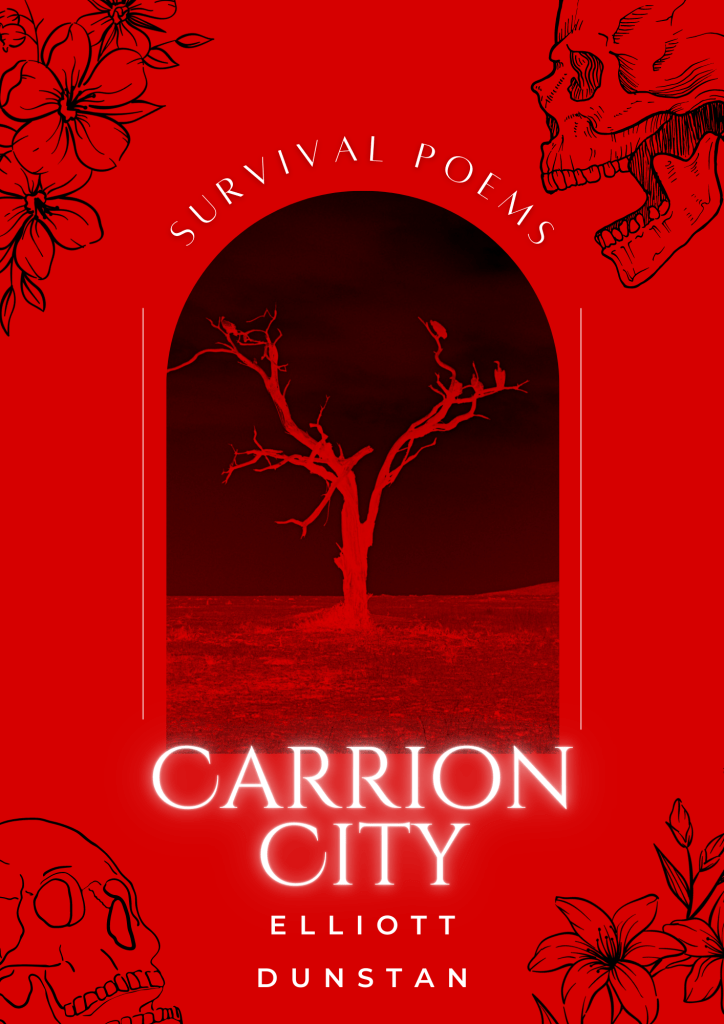
  • “CARRION CITY” up for sale!

    January 30th, 2024

    I’ve been putting this off for ages (and yes, my new schedule immediately slipped, but I hate Januarys, that’s my excuse–) but CARRION CITY is finally up for sale as an ebook! CARRION CITY is a visual collection of poetry and prose centered around housing and financial insecurity, poverty, and both internal and external crisis.

    Buy: https://payhip.com/b/6HtbX
    Goodreads: Review it here!

    Please note that CARRION CITY is 18+ and features themes of sexual assault, drug use/abuse, parental abuse, and unreality/mental illness.

  • Travelogue Tuesdays: Celabria – Li Ottavu Poddha (The Eight City-States)

    January 9th, 2024

    On the northwest border of Elessa and also bordering the country of Vijarok, Celabria’s history with Elessa is a long and complex one. The country is much smaller, only physically being about the size of County Forcett, and is further subdivided into a number of city-states who are often at war with each other – only offering a united front when it comes to enforcing their shared identity as Celabrians against ‘outsiders’. The irony, of course, is that Celabrians are by and large descendants of the same desperate escape across the ocean as Elessans, although the oral history of the migration differs greatly between the countries. (Elessans hold that Elessa, or Torya, is the original birthplace of all humans; Celabrians have a more practical and aggressive ‘finders keepers’ perspective on the whole thing.) Additionally, Celabria’s perspective on indigenous Celabrians is far more relaxed than Elessa’s apartheid policies on the five clans; while discrimination and racism are no less a problem in Celabria, centuries of intermarriage have changed the political landscape dramatically.

    Celabria’s eight major city-states (not including smaller vassal cities) are as follows:

    Korsicia, ruled by King Augustu III
    Siracusu, ruled by Queen Steddha I
    Venecu, ruled by King Ludovik IX
    Kastili, ruled by King Karlo I
    Aragon, ruled by Queen Caterina II
    Andaluci, ruled by King Tuccius I
    Cediz, ruled by King Giovanni IV
    Napoli, ruled by King Periklu VI

    Of these, Napoli has the closest ties with Kallisto’s old regime and thus with the Garrow family, while Kastili was a supporter of Forrath and in fact supported his war on Celabria due to how it weakened his enemies – Kastili is the city-state furthest from the Celabria-Elessa border. (This has damaged diplomatic efforts between Kastili and just about everybody else, but King Karlo I is a gifted thaumatist and all attempts on his life thus far have failed, so they just have to put up with him until he keels over.)


    Out of Universe Notes:

    Celabria is a mix of Sicilian, Tuscan-Italian and Spanish influences! While I don’t know how much the country itself will feature in the series, its influence is important, especially on Meergaarten and Anselm (the counties it borders).

    Want to support Bell Clock and Candle? Support me on Ko-Fi!

  • Magic Mondays – Songwork

    January 8th, 2024

    “The instincts of a Bard are, I fear, beastly in nature; it seems the most skilled Bards are those who carry the power of the mountain’s echo, the crash of the avalanche or the wail of the winter wind in their song, and who do it with so little applied thought or theory that it seems that they were born simply with it in their blood. It makes it easy — too easy — to doubt the scientific nature of the discipline.” — Jack Gavinsohn Alfritz, in an opinion letter to the Den Elessa Times, 1899.

    Songwork is one of the four disciplines of structured magic, or thaumaturgy, in use in the State of Elessa. Colloquially called Bard magic, it is the oldest and most well attested of the four schools, with clear historical references predating even Bloodwork. The most prominent — and obvious — of these is the Drowned Bard himself, but while Proteus is occasionally shown working miracles through poetry and song, these are relatively few and far between when compared to the magic and music of the Three-Tongued Pilgrim. In the work of Otfrid of Wessenbrijk (1500s), our earliest attested work featuring Merlin and indeed any of the Nine Heroes, Merlin’s three faces are said to represent the three types of art — Inktkunst (art of paper and ink), Talakunst (art of the tongue) and Forkunst (art of the hand and body). Roughly speaking, this translates to writing and art as the first; song and speech alike as the second; and dance, the work of an instrument, and performance as the third. Even crossing from folklore into recorded history gives us a wealth of instrumental and vocal mages, from Rosette Lammasdottir (late 1500s, vocalist) to Hieronymus Locke (1720s, harpisichordist and pianist).

    In sharp contrast to Smokework, Songwork is much less systematized. Music theory, of course, is a thriving field, and there are magical mechanisms attached to every bit of musical theory, from the modes (Aeolian, Lydian, etc.) to key signature and rhythm, to the nature of a composition (iterative, progressive, so on and so forth.) There are even names for particular compositions with particular effects, slotted into types and categories of spells, meant as stand-ins before a Bard gets around to composing their own work (as they are always expected to do). But at its heart, Songwork is a deeply felt discipline. It is all very well and good to know what artefacts such as the ‘devil’s interval’ are (two notes separated by three whole tones or six semi-tones) but a true Bard knows how to surround it with the correct notes, the correct timing, the correct words (depending on their style) to evoke the needed emotion from those around them.

    A lack of full systemization in spell natures does not, however, mean that the Bards themselves do not have their own separate schools. Within the Bard College, there are Troubadours, Virtuosos, Balladeers, and Rhythmists. Troubadours focus primarily on folk-styled music, and play a mix of instruments but normally simpler ones; the violin, (wooden) flute, uillean or bag-pipes, lutes or small guitars, balalaikas and accordions. (The only recorded accordion player in Songworker history, at least as his primary instrument, is Fayvel Bar-Nohra in 1848. Still, as a result, it is an accepted and studied instrument.) Virtuosos are classically inclined, and tend towards larger compositions played in a stationary position. As such, Virtuosos will play instruments such as piano, harpsichord, silver flute, clarinet, cello and so on. There are also instruments that overlap depending on size and use — violins and harps are found in both schools with quite a bit of regularity. Balladeers are the only school that regularly uses lyrical music, although some lyrics may appear in Troubadour craft here and there. The interplay of words and music is where their interest lies, and so they may play any of the above instruments, barring any of the wind or reed; violins are also rare due to their positioning. The most common instruments for a Balladeer are lute, guitar, or small harp. Finally, the Rhythmist school is the youngest; while it has had a presence in the College since the late 1890s, the rising popularity of moving pictures has created an unexpected rise in drummers. While piano players provide the soundtrack for films in-house, drummers are the Foley artists of the movie theatre, and the combination of the heightened emotion of any film with the nature of a drumpad has created (and continues to create) a massive number of new Rhythmist Bards. These Bards work with any kind of drum or percussion instrument; bass guitars and double basses often appear but are second line to the bodhran, tambourine, snare drum, and even ‘instruments’ as humble as castanets or rainsticks. Not included in the Bardic College, and in fact looked down upon by the leaders of such, are Minstrels — unregistered Bards who have learned next to no theory at all, but somehow have enough of a deft hand with the magic to use it skilfully anyway, and are sneaky enough with it to avoid being arrested as unregistered thaumatists. Most Minstrels are jazz or blues performers, which is a fascinating coincidence, if you listen to the Bardic College about it.

    The Songwork (or Bardic) College is the oldest of the Colleges, founded in 1732 and awaiting the celebration of its 200th birthday with both trepidation and great excitement. Its early years were markedly different, focused primarily on teaching the skills of music rather than magic, and in fact early surviving documents bear conflicting mastheads of ‘Bardic College’ and ‘Bard’s Guild’, demonstrating internal strife on the exact purpose of the institution. By the 1740s, however, this strife was clearly resolved and the first true class was accepted as a group. The only major disruption in the Bardic College’s history is during the Civil War of 1909-1911, where the College decided not to accept any new students for ’10 or ’11, and the leadership of the College was torn between the opposing factions of the war.


    Out of Universe Commentary:

    Doing music-magic is always tricky when you know just enough music theory, but I had fun with this! Most of this will end up in the story as well given that one of Rook’s favourite schools is Bard magic — and to forestall any concerns, the bit about Minstrels is very, very deliberate. (You will meet at least one Minstrel.)

    Keep coming back for more worldbuilding posts! And don’t forget — if you want to subscribe and help me out, my new monthly support platform is over on Ko-Fi!
←Previous Page
1 … 9 10 11 12 13 … 62
Next Page→

Start a Blog at WordPress.com.


Loading Comments...
 

    • Subscribe Subscribed
      • Elliott Dunstan
      • Join 167 other subscribers
      • Already have a WordPress.com account? Log in now.
      • Elliott Dunstan
      • Subscribe Subscribed
      • Sign up
      • Log in
      • Report this content
      • View site in Reader
      • Manage subscriptions
      • Collapse this bar